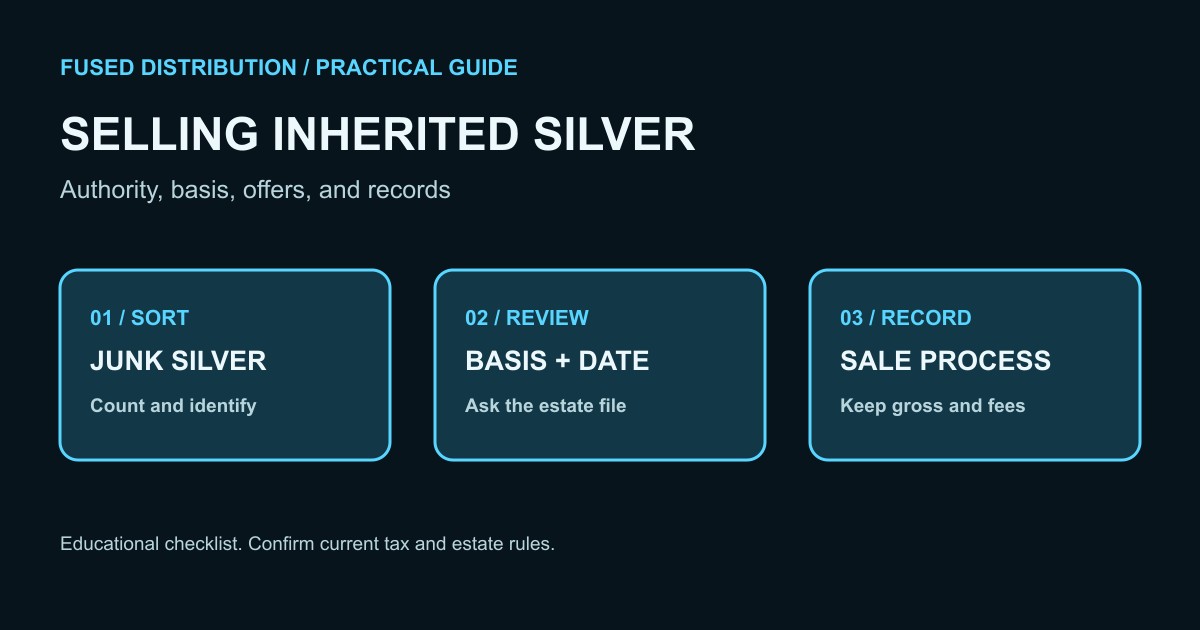
Selling inherited silver is two tasks at once: completing an authorized estate transaction and creating records that explain what was sold, when, and for how much. The practical steps below are educational. Estate documents, state probate rules, and your tax facts control, so ask the executor’s professional advisers and a tax professional to review the transaction.
Confirm who is authorized to sell
Start with authority, not a buyer. The person holding the coins may be an executor, personal representative, trustee, beneficiary, or family member without authority to dispose of estate property. Read the will or trust and check the appointment documents. If probate is open, follow the court and estate professional’s instructions. A beneficiary may eventually receive the coins but may not be able to sell them before distribution.
Write down the collection’s custodian, the date it was received, and any agreed division or authorization. If multiple beneficiaries are involved, document whether the sale is for the estate, for one beneficiary after distribution, or for an agreed buyout. Do not rely on a verbal family agreement for a material asset.
Use the inherited silver inventory guide to organize the collection, and the inherited junk silver guide for mixed circulated coins.
Inventory before contacting a buyer
Photograph the collection in place, then assign an item or group ID. Record denomination, date, mint mark, maker, stated fineness, weight, packaging, condition, and count. Separate ordinary circulated coins from key dates, proofs, graded pieces, bars, foreign coins, medals, and uncertain objects. Preserve holders and envelopes. Do not polish, scratch, drill, or acid test a coin.
For common US coins, the date and denomination are useful sorting clues, not authentication. Many US dimes and quarters dated 1964 or earlier are 90 percent silver by alloy weight. Kennedy halves dated 1965 through 1970 are generally 40 percent silver. Modern lookalikes and special issues exist. Keep a separate face-value column. For example, 20 pre-1965 US quarters equal $5.00 in face value, before any metal or collector value. A buyer may quote by count, face value, gross weight, or estimated fine silver content, so record the quote’s basis.
Establish the relevant basis and date
The tax starting point for inherited property is often fair market value at the date of death, but the governing facts can include an estate election for an alternate valuation date, the way the property was transferred, and whether an exception applies. Ask the executor for the estate inventory, appraisal, and any supporting schedules. Do not substitute today’s spot price for the estate’s documented valuation.
Create a basis worksheet with the item IDs, valuation date, appraisal method, assigned value, later improvements or costs if relevant, and supporting documents. If coins were distributed in different lots, map each lot to the estate records. A professional appraiser may use a different method for common bullion and collectible coins; ask the appraiser to state assumptions and the intended use of the opinion.
Decide what kind of sale fits the material
Common circulated coins may be sold as a documented group. A key date, unusual variety, proof, graded coin, or complete set may deserve a numismatic opinion before a metal buyer sees it. For bars, record maker, serial number, stated fineness, weight, and assay packaging. Keep uncertain and plated objects out of the silver lot until identified.
Compare written offers from appropriately vetted buyers. Each offer should identify the items, pricing basis, fees, payment method, shipping responsibility, insurance, and return terms. A dealer’s quote is a market offer, not automatically an independent appraisal. A specialist auction or consignment route may fit rare material but can add time and fees. Preserve declined offers when the estate needs to show how a decision was made.
Complete the sale with a paper trail
Before shipping, agree in writing who carries loss risk, which service is used, how insurance works, and when title transfers. Keep a copy of the inventory, photographs, signed authorization, appraisal, offer, invoice, shipping receipt, payment confirmation, and final settlement. Reconcile the items shipped with the item IDs received by the buyer.
Record gross proceeds and each deductible or transaction cost separately. Do not describe a net check as the sale price. Note the sale date and whether the proceeds went to the estate account or to a beneficiary after distribution. The executor or tax professional can then match the transaction to the estate’s accounting.
If the buyer pays by weight, preserve the weight calculation and the scale units. If the buyer pays by face value, preserve the denomination count that produced the quote. If a lot contains collectible pieces, ask for a line-item offer rather than allowing the buyer to merge every coin into a melt lot. For a remote sale, compare the insured shipping amount with the value declared on the invoice and retain tracking through delivery. These details give the estate a repeatable explanation if a beneficiary later asks why the net payment differs from the initial quote.
Review inherited silver taxes before filing
A sale of inherited capital property is generally treated as long term regardless of how long the beneficiary actually held it. The exact result depends on the asset and facts. Ask a tax professional to classify the property and apply the appropriate reporting forms.
Silver held as an investment is not automatically taxed like ordinary personal-use property. Collectibles can be subject to a maximum 28 percent long-term capital-gain rate, but that is a maximum rate and not a flat tax on every sale. The taxable gain calculation depends on proceeds, basis, and permitted selling expenses. Do not promise a rate before the professional reviewing the return confirms the classification.
Loss treatment also depends on use. A loss on personal-use property is generally not deductible, while investment property can have different rules and documentation requirements. A collection held by an estate, a distributed collection, and a dealer’s inventory are not interchangeable categories. Ask which taxpayer owned the coins at the time of sale and keep that determination with the return records.
<div class="math-box"><h3>Illustrative sale record</h3><p>Gross proceeds $1,000 - permitted selling expenses $50 - documented basis $800 = $150 gain.</p><p>These hypothetical amounts illustrate record keeping. The applicable tax rate and allowed expenses require the seller’s actual facts.</p></div>
A controlled sale checklist
- Confirm the executor, trustee, or beneficiary’s authority in writing.
- Photograph and number the collection before sorting.
- Record count, denomination, date, face value, purity clues, and condition.
- Separate possible collector pieces from common metal lots.
- Obtain the date-of-death valuation and ask whether an alternate valuation date was elected.
- Get a written appraisal when rarity, division, or value makes it useful.
- Compare offers that state basis, fees, insurance, and payment terms.
- Ship only after authorization and risk of loss are documented.
- Reconcile gross proceeds, fees, and net payment to the item IDs.
- Give the complete file to the executor and tax professional before filing.
The IRS discusses inherited basis in Publication 551, estate administration in Publication 559, and sale reporting in its capital gains and losses guidance. The IRS also explains the tax treatment of gifts and inheritances. Read current instructions with the estate professional because the correct answer depends on ownership, valuation, use, and records.