Finding a box of inherited coins can create two problems at once: you need to protect an estate asset, and you need to identify what is actually in the box. “Junk silver” is a market description for common circulated coins valued mainly for their silver content. It does not mean worthless, damaged beyond use, or safe to sell without checking.
Start with authority and a record for inherited junk silver
Before moving, cleaning, dividing, or selling the coins, confirm who may act for the estate. That might be an executor, personal representative, trustee, or beneficiary whose authority has already been established. A family relationship alone does not settle that question. Keep the will, trust, court appointment, inventory, and receipts together. If authority is unclear, ask the estate lawyer or probate court before making a sale.
Store the collection in a dry, controlled place with limited access. Photograph the box and its contents before sorting. Give each tray, envelope, or group an inventory number. Record who handled it, when, and why. This simple chain of custody helps prevent disagreements later.
Sort by denomination and date
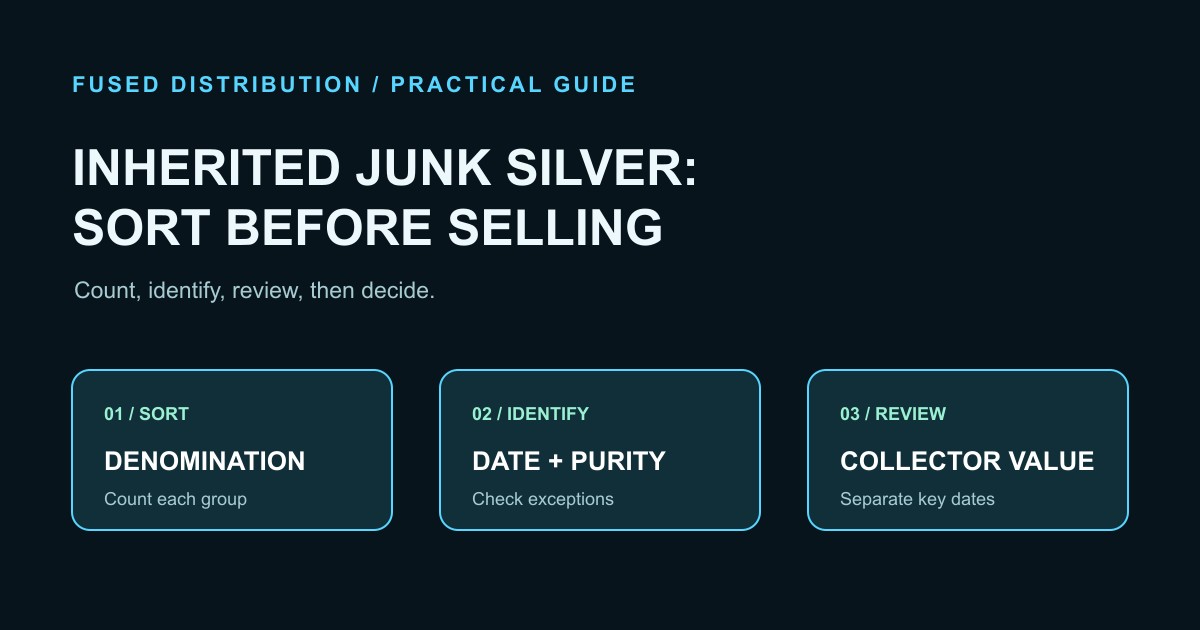
Spread the coins on a clean, soft surface and sort them without polishing. Make separate groups for dimes, quarters, half dollars, silver dollars, foreign coins, tokens, medals, and pieces whose composition is uncertain. Record the date, mint mark, denomination, visible condition, and any packaging. Keep key dates, proofs, graded coins, unusual varieties, and complete sets apart from common circulated pieces.
The US Mint coin specifications and its historical half dollar production material are useful identification references, but a specification does not authenticate a particular coin. Weight, diameter, edge, magnet response, and a professional examination can help resolve uncertainty. Do not drill, scratch, acid test, or otherwise alter a coin.
Understand the major composition rules
Many US dimes and quarters dated 1964 or earlier contain 90 percent silver by alloy weight. Kennedy half dollars dated 1964 are also 90 percent silver. Kennedy halves dated 1965 through 1970 are generally 40 percent silver. Those date ranges are identification clues, not a substitute for checking the individual coin.
There are exceptions and lookalikes. Modern clad coins can share the same denomination and similar appearance. Some silver dollars, commemoratives, foreign coins, proof issues, and special releases follow different specifications. A coin may also carry collector value above its metal value because of rarity, condition, mint error, provenance, or packaging. Never put every coin from one inherited box into a single bulk category without reviewing it.
Keep collector value separate from metal value
Common circulated pieces may be evaluated as a group, while a scarce date or sharply preserved coin may need a numismatic opinion. Keep original holders and envelopes. Do not remove toning, wash dirt away, or use silver polish. Cleaning can leave marks that reduce collector value, even when the coin looks brighter.
Separate silver-plated objects and uncertain pieces until identified. A stamped word such as “silver” can describe plating, an alloy, or a genuine precious-metal item depending on the object. Bars should be recorded by maker, stated fineness, weight, serial number, and packaging. Photograph both faces and the edge or certificate.
Choose the right appraisal
Ask a qualified numismatic or precious-metals appraiser what question the appraisal will answer. Estate reporting, equitable division, insurance, and a possible sale can require different methods and valuation dates. For a collection with key dates, graded pieces, unusual bars, or family disagreement, seek a second opinion and disclose that the property was inherited.
Use written offers that identify the items, price basis, fees, payment method, and return terms. Compare more than one vetted buyer. A local dealer may offer convenience; a specialist auction or consignment route may fit unusual collector material. Record every offer and the final disposition in the estate file.
Handle tax questions carefully
See our inherited silver inventory guide for a companion recordkeeping checklist. Use the estate valuation guide to prepare the appraisal record. The IRS discusses basis, inherited property, and executor responsibilities in Publications 551 and 559. The correct treatment depends on the facts, the estate documents, valuation date, holding history, and the transaction. Keep the inventory, appraisal, date of death records, sale invoice, shipping receipt, and payment record. Ask a tax professional how the rules apply before filing or selling.
The US Mint’s coin specifications and the IRS publications are starting points for research. They do not determine authenticity, a buyer’s offer, or every tax result for a particular inheritance.
A practical decision checklist
Use a worksheet with columns for item ID, denomination, date, mint mark, count, face value, stated fineness, estimated silver content, condition, and notes. Count by denomination before discussing a price. For example, 20 pre-1965 US quarters have $5.00 in face value; that face value is separate from any silver or collector value. A buyer may quote by count, face value, gross weight, or estimated fine silver content, so write down the basis and ask what deductions apply.
For a first pass, count dimes, quarters, and half dollars in separate rows. Then record a second row for 1965-1970 Kennedy halves, whose composition differs from 1964 halves. Do not use a single multiplier for a mixed bag. Label estimates as estimates and retain the underlying dates and counts so another reviewer can reproduce them.
Common mistakes to avoid
Do not assume a date alone proves silver content. Verify the denomination and series, because a modern coin can look similar to an older one and special issues can follow different specifications. Do not assume that every 1964 or earlier coin is collectible, either. Many are common circulated pieces, while a small number of dates, mint marks, varieties, or proof strikes can deserve separate treatment. The purpose of sorting is to preserve those possibilities until someone qualified can assess them.
Do not mix the estate’s ownership question with the pricing question. An attractive offer does not establish that the person receiving it had authority to accept it. If several heirs are involved, record the proposed division and the valuation method before anyone takes a group home. A fair division may require equal value rather than equal count, and sentimental items may need an agreed process of selection or offsetting payments.
Do not treat an online calculator as an appraisal. Calculators can help organize a count or compare a documented specification, but they cannot detect a counterfeit, grade condition, recognize every variety, or determine what a buyer will pay. Keep calculations as working papers and label their assumptions. When the decision has meaningful financial or family consequences, obtain a signed opinion from a qualified professional.
Do not ship the collection before agreeing on insurance, tracking, responsibility for loss, and the written offer. Keep digital scans of the inventory and photographs in a secure location. If the estate is in probate, coordinate with the person responsible for the case and preserve the original records. A careful process may take longer than a cash offer made at the door, but it leaves the estate able to explain what happened and why.
Confirm authority. Secure the collection. Photograph and number every group. Sort by denomination and date. Isolate key dates, proofs, graded coins, foreign pieces, plated objects, and uncertain material. Do not clean or alter anything. Obtain qualified opinions where the value or ownership is disputed. Compare written offers. Preserve the complete record.
Inherited junk silver can be manageable when identification comes before pricing and documentation comes before division. Take the time to separate common metal value from possible collector value, and use qualified legal, appraisal, and tax help where the estate requires it.
Sources: US Mint coin specifications, IRS Publication 551, and IRS Publication 559.