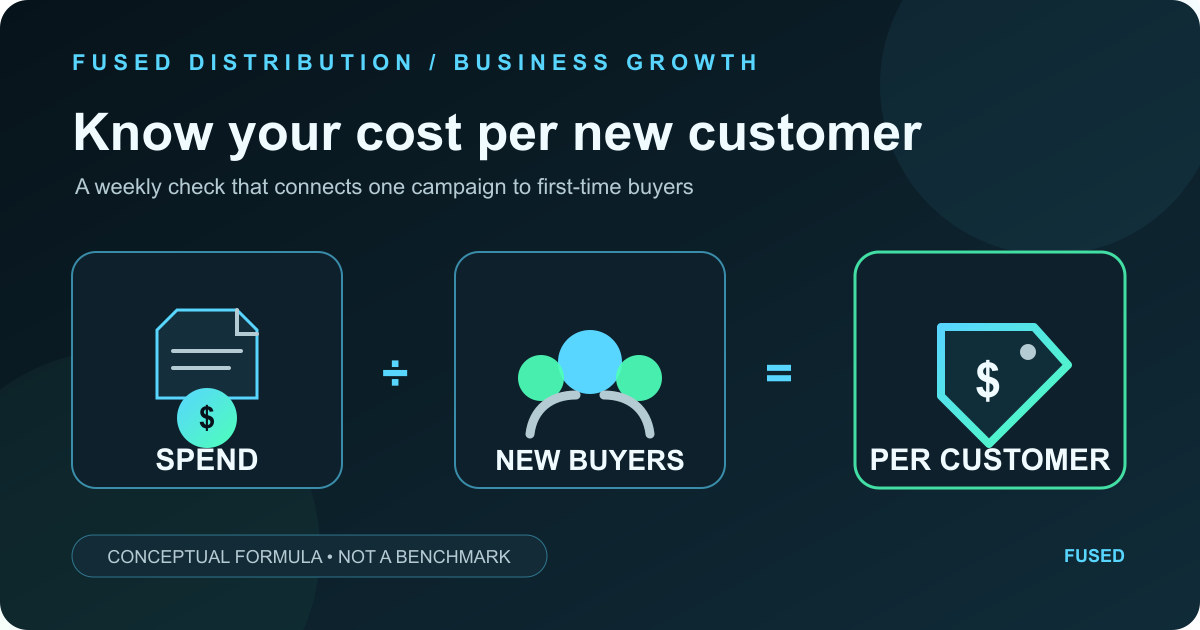
Weekly promotion spend → $300
New customers attributed → 10
Cost per new customer → $30
A weekly marketing report can show plenty of activity: views, clicks, calls, form fills, and sales. But one simple number helps connect the spending to the result: customer acquisition cost, or CAC. It asks, “How much did we spend to bring in each new customer?”
SCORE’s marketing planning guidance describes the basic calculation: divide the money spent on a marketing tactic by the number of new customers attributed to it. That gives an estimate for that tactic. It is not a universal score of whether your business is healthy. It is a way to compare a defined effort with the customers it produced.
What customer acquisition cost tells you
At its simplest, customer acquisition cost is:
Cost of a marketing effort ÷ new customers attributed to that effort = cost per acquired customer.
Suppose, as a made up example, a shop spends $300 on a local promotion in one week and can reasonably connect 10 first time customers to it. The calculation is $300 divided by 10, or $30 per new customer. Those numbers are only an illustration, not a benchmark or a claim about a real business.
That result gives the owner a question to investigate: did the promotion bring customers who made a worthwhile purchase, and would the result hold if the effort continued? The $30 figure alone cannot answer either question. A $30 acquisition cost may be manageable for one business and too high for another. The answer depends on what the business sells, the costs of delivering it, whether the customer returns, and the time period used.
Define the calculation before you use it
A metric is only useful when its boundaries stay clear. Pick a time period, a customer definition, and which costs you include. For a small weekly check, you might start with the direct cost of one campaign and count first time paying customers that came from it.
SCORE’s marketing guide lays out this same tactic based calculation, and advises revising an estimate after actual results come in. That is helpful because expected reach and actual buyers are not the same thing. Keep estimates separate from observed results. If you paid for an advertisement this week but customers usually take longer to decide, label the calculation as preliminary and revisit it after a suitable delay.
Also decide whether you are measuring one channel or the whole business. A campaign level number can help compare a local event with an online ad, as long as the accounting rules are the same. A broader business number may include staff time, software, creative work, sales commissions, or other costs. Neither boundary is automatically correct for every decision. Write down what is included so next week’s comparison means the same thing.
Track sources without pretending attribution is perfect
Customers may hear about a business in several places before they buy. Someone might see a social post, get a referral, then search the business name. A single source field cannot capture every influence. Make the question easy to answer at checkout or in an inquiry form: “How did you first hear about us?” Offer a short list and an “other” option. Keep the answer with the lead or sale record.
Use links with campaign tags when appropriate, and keep a simple log for calls, walk ins, and referrals that happen offline. Do not treat platform clicks as customers. A click is a step, not a completed sale. If the source is unknown, record it as unknown rather than assigning it to whichever channel looks best.
For a small operation, a spreadsheet can be enough. Add the week, campaign, spend, number of new customers, source method, and notes about delays or uncertainty. The point is not to create a perfect measurement system before taking action. The point is to use one definition consistently and improve the records as you learn.
A five minute weekly review
Start by gathering the costs for each active marketing effort. Use invoices, ad accounts, event receipts, printing costs, or referral fees. Keep the records for each channel separate. Then count new customers connected to each effort during the same measurement window. Divide each effort’s spend by its attributed new customer count.
If the count is zero, do not divide. Record that the effort has spent money without a tracked new customer in that window, then check whether the sales cycle is longer or the tracking is incomplete. One quiet week may not prove the channel will never work. Several comparable periods give you better context.
Next, compare the result with what those customers buy and what it costs to serve them. This article is general business education, not accounting or financial advice. If you need to make a major budget decision, or are unsure how to treat labor and other expenses, ask an accountant or qualified business adviser to help define the calculation for your records.
Finally, write down one decision for the next week. You might keep the campaign steady while you improve tracking, test a small change, or pause spending until you understand a weak result. Avoid changing several things at once. If the number moves, you want to know what changed.
What this number cannot tell you
Customer acquisition cost does not measure customer satisfaction, repeat buying, profit, or cash flow. It also cannot prove that one channel caused a sale when several touchpoints were involved. The number can be misleading if costs are omitted, customers are counted twice, or the campaign has not had enough time to work.
It is also not a target you can copy from another company. SCORE and the Small Business Administration both frame marketing budgets as dependent on the specific business and its plan. Your own records are more useful than a generic number without a matching industry, offer, time period, and cost definition.
Use the weekly check to notice questions earlier. If one channel’s cost rises, inspect the campaign and the tracking before making a large cut. If a channel looks inexpensive, confirm that the customers are real buyers and that the result includes the costs you intended to count. The metric starts a decision. It does not make the decision for you.
Before you compare channels, review one related guide on tracking customer questions and one on small business marketing channels. Those records can help you connect inquiries to later purchases.
Make the next week easier to measure
Choose one campaign, define “new customer,” and record its direct cost and resulting first time buyers. Keep uncertain sources visible. At the end of the week, calculate the cost per acquired customer, compare it with the prior period only if the definitions match, and choose one measured next step.
That small habit turns marketing from a list of disconnected activities into a question you can revisit. You do not need perfect attribution to begin. You do need honest boundaries, consistent notes, and a willingness to revise an estimate when actual results arrive.
Sources
- SCORE, “Business Plan 101: Sales & Marketing,” accessed October 31, 2026: https://www.score.org/articles/business-plan-101-sales-marketing/
- SCORE, “Marketing Plan Guide,” accessed October 31, 2026: https://www.score.org/e-guides/marketing-plan-guide/
- U.S. Small Business Administration, “How to Get the Most From Your Marketing Budget,” July 9, 2019: https://www.sba.gov/blog/2019/2019-07/how-get-most-your-marketing-budget/
Related
- How To Collect Customer Contact Info At Point Of Sale
- SMS Marketing Vs Email Marketing Small Business
Read next: How To Collect Customer Contact Info At Point Of Sale