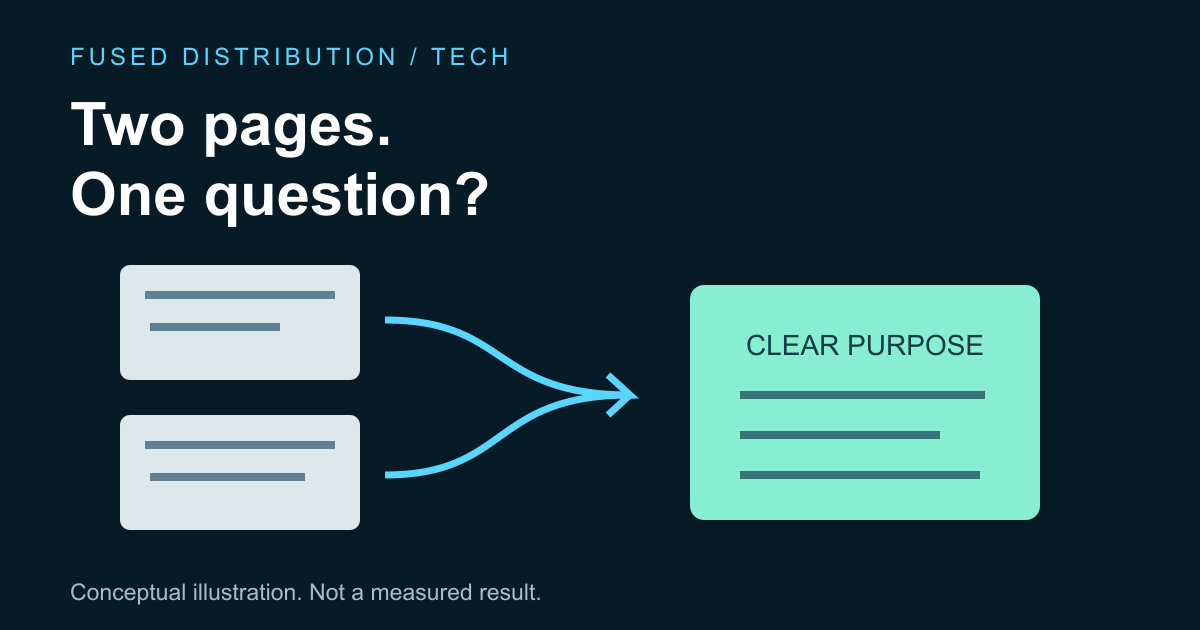
Compare visitor purpose → Review the overlap
Choose URL behavior → Preserve useful paths
When two service pages answer the same question, compare the visitor's purpose before deciding to merge them. Similar wording can hide different needs, while different page titles can lead to essentially the same answer. The useful decision is which page structure gives a visitor a clear, accurate route through the service information.
This is a content review workflow, not a promise that consolidating pages will improve search rankings. It separates the editorial decision about what visitors need from the technical work of managing URLs. Keep both parts in the change record so a developer does not have to infer the business's intent from a redirect request.
Compare what each service page helps someone do
For each page, write one sentence describing the intended visitor and the decision the page supports. Use the actual content rather than the title alone. Read the service scope, conditions and next action. If the answer differs by service or circumstance, that difference may justify separate pages even when they share some background.
Make an inventory of useful information on both pages before editing either. Mark current explanations, outdated statements, unsupported promises and material that needs an owner to verify it. Do not assume the longer page is better. A shorter page may explain the decisive condition more clearly, while the longer one repeats material without helping the visitor act.
Our guide to planning pages around customer questions provides a way to connect questions with decisions. Use that connection here: two pages belong together only when a combined explanation can serve the relevant need without concealing a distinction that matters to the customer.
Decide whether the overlap is useful
Some repeated context is reasonable when two distinct services require it. In that case, sharpen each page's purpose and keep shared facts consistent. Give each page a descriptive title and a next action appropriate to its service. Do not force a merger simply because both pages contain the same introduction or contact information.
If the pages serve the same purpose, draft a proposed combined outline before removing content. Preserve accurate details from both and resolve contradictions with the service owner. The outline should show what visitors can learn and what they can do next. It should also identify any claim that still needs confirmation before release.
Use an explicitly hypothetical example when discussing the choice internally: two booking pages might differ only because one is an abandoned rewrite, or they might describe different appointment types. Those situations call for different treatment. The presence of two URLs alone cannot tell you which situation applies to your business.
Match the URL treatment to the decision
Google describes redirects and canonical annotations as signals for selecting a preferred URL among duplicate or very similar pages. These mechanisms have different practical effects. A redirect sends a visitor elsewhere; a canonical annotation does not itself replace the visitor's page. Select the mechanism that fits the intended behavior and the site's technical setup.
If one page is being retired and an appropriate replacement exists, ask the developer to implement and test the suitable redirect. If multiple versions must remain accessible, discuss whether a canonical annotation is appropriate. Google's documentation also makes clear that the search engine can choose a different canonical; a declaration is not a guarantee of selection.
Do not use robots.txt blocking or a removal request as a substitute for resolving a canonicalization question. Follow the Google canonical URL guidance for the technical details. The service owner should approve the content relationship, and the implementer should verify the mechanism against the site's actual behavior.
Preserve the path visitors already use
List the internal links, navigation entries and calls to action that refer to either page. Update them to the intended destination when consolidating. Check that the destination answers the promise made by each link. A technically successful redirect can still disappoint a visitor if it lands on a generic page that does not address their question.
Check important form links and downloadable instructions as well as the main text. If a service condition changes during the edit, have the responsible owner confirm it. Keep unrelated policy changes out of a page consolidation unless they have been deliberately approved. This makes the release easier to review and any later correction easier to understand.
Our website change review checklist can support the release check. Test the old and new URLs, the visible content and the route to the next action. Record observed results rather than marking a task done simply because a configuration file contains the expected line.
Review the combined page after release
Read the live destination on a phone and a larger screen. Follow its main links and confirm that the important service conditions remain easy to find. If the original pages had genuinely different audiences, check that the revision has not buried one audience's answer beneath a broad introduction intended for everyone.
Keep a dated note of the decision, the affected URLs and the owner of the remaining content. Monitor available feedback and relevant site data without inventing a before and after result. If the new structure causes confusion, use that evidence to refine it. The goal is a maintained explanation of the service, supported by predictable navigation and accurate technical behavior.
Sources
- Google guidance on canonical URLs: canonical signals and technical cautions. The service page comparison workflow is original editorial guidance.
Related
Read next: Review the actual website change.