Collect actual questions → Group customer decisions
Own each answer → Test the next step
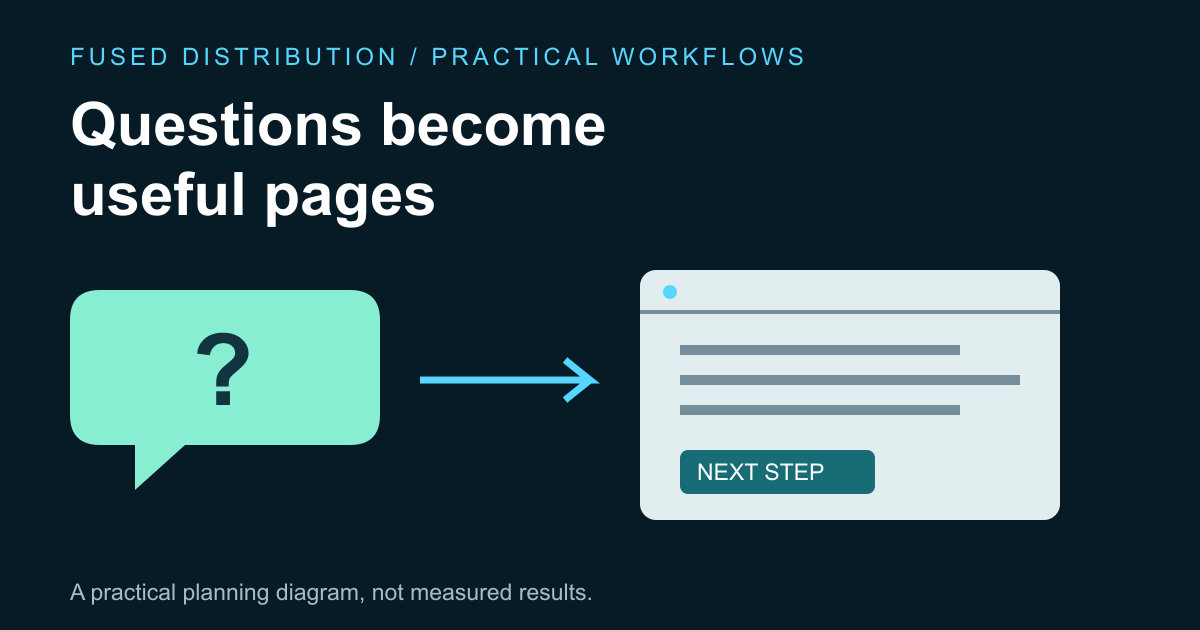
Plan a business website by listing the questions a customer needs answered before taking the next step. Then give each important question a clear home, an accurate answer and a useful onward action. This approach connects the site structure to real decisions instead of beginning with a collection of page titles or a visual theme.
The method below is a proposed planning exercise. It does not promise search rankings, traffic or sales. Its immediate output is a reviewable page map: what each page helps someone decide, what evidence supports the answer and where a visitor should go next.
Collect customer questions in their own language
Start with questions your team actually receives, using records you are permitted to review. Remove personal information from the working notes. Keep the question's meaning even when you simplify its wording. Do not turn one customer's detailed situation into a public example without the necessary permission.
Separate observed questions from questions the team merely expects. Both can inform planning, but the distinction matters when deciding priorities. A suggested question is a hypothesis to test. A recurring question supported by your records has a different evidence base. Neither automatically tells you how much search demand exists.
For each question, note the context. “How long does it take?” may refer to scheduling an appointment, completing work or receiving a response. Those are different answers. Clarify the customer decision before writing copy, or a polished paragraph may answer the wrong version of the question.
Group website questions by the decision
Arrange the questions into a small number of decisions, such as whether the service fits, what preparation is needed, how the work proceeds and how to request the next step. These are examples to adapt, not required sections for every business. Use the actual service and audience to choose the groups.
Do not create a separate page for every slight wording variation. First ask whether the visitor needs a distinct answer. Several related questions may belong together on one useful page. Conversely, a question that requires a different service explanation or a different action may justify its own page. The page map should make those distinctions visible before design work begins.
Google's SEO Starter Guide recommends useful, readable content and clear organization. That supports making pages understandable; it does not guarantee a ranking from a particular question format. Treat search guidance as context while keeping the customer's actual need at the center of the plan.
Give every page an answer and an owner
For each proposed page, write its main question, a short answer, the source of that answer and the person responsible for keeping it accurate. Business details such as service scope, coverage and response expectations should come from the responsible team, not from generic copy or an AI guess.
Identify unresolved details openly in the internal planning document. Do not publish a placeholder promise because the final policy is still being discussed. A missing answer may reveal that the business needs an operational decision before the website can explain it accurately. Assign that decision rather than asking the designer to invent a convenient sentence.
Our website access guide can help organize the separate question of who can maintain the site. Content ownership and login access are related, but one does not automatically establish the other. Make both responsibilities explicit in your working records.
Connect the answer to a useful next step
After reading the answer, what should a visitor be able to do? The action might be reading a more detailed service explanation, preparing information for a request or using a contact form. Choose an action that matches the page's purpose. Repeating the same vague button everywhere can hide important differences between those decisions.
Write link labels that describe the destination or action. Check that the destination actually completes the expected step. A page saying “request an estimate” should lead to a functioning request path, not simply to an unrelated homepage. Use the guide to checking broken booking links for a practical example of verifying the destination.
Keep contact requirements proportionate to the request. The page map should show what information the next step needs and why. If the team cannot explain a requested field, revisit the form before treating its current structure as a fixed design constraint.
Test the website plan before polishing it
Use the draft page map to walk through a realistic customer question. Ask someone unfamiliar with the plan where they would look and what they would do after reading the answer. Record the route they choose and any missing information. This is a suggested review exercise, not a claim that a small test proves broad usability.
Separate failures of organization from failures of wording. If the right answer exists but the reviewer cannot find it, examine navigation and labels. If the answer is easy to find but does not resolve the question, repair the content. If the next action fails, check the destination and form behavior. These problems need different repairs.
Keep the question map current
After launch, assign a review when a service, policy or contact process changes. Record what changed, which pages contain the affected answer and who verified the update. A customer question can be answered in several places, so check linked pages and supporting text rather than editing only the most visible heading.
Save the original planning map alongside the update notes. It gives future maintainers a reason for each page and makes unexplained duplication easier to notice. Add new pages when they serve a distinct need, and review older answers when that need changes. The goal is a site a customer can use and a team can maintain with clear responsibility.
Sources
- Google SEO Starter Guide: readable content and site organization. The question-mapping exercise is original planning guidance, not a ranking claim.
Related
Read next: Verify the destination behind a booking link.