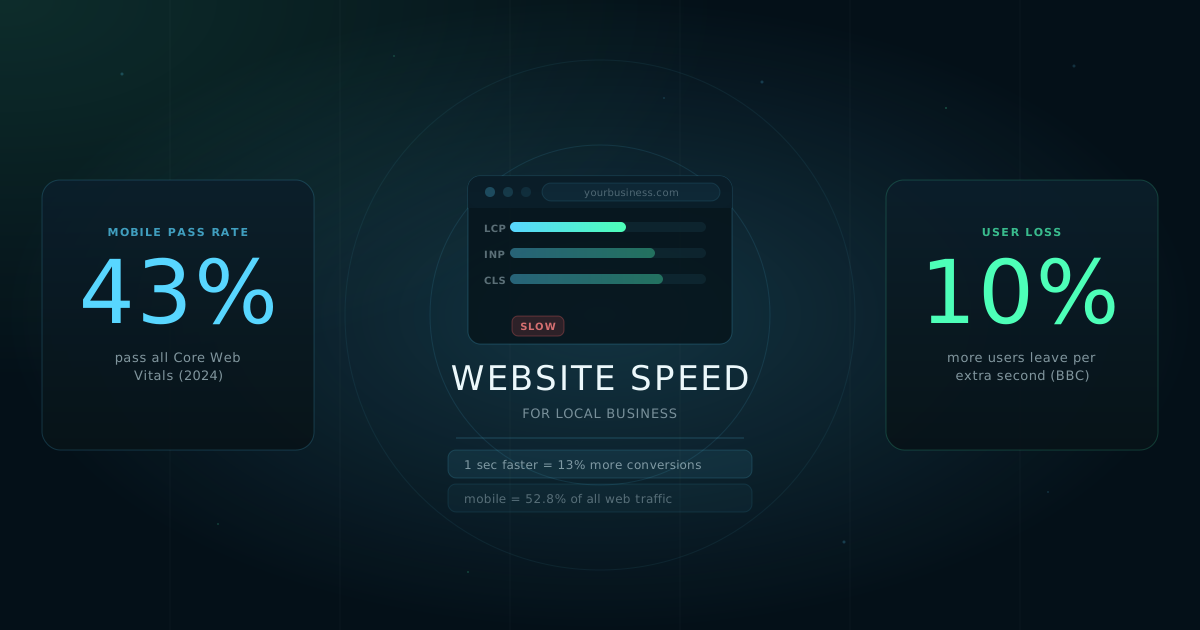
In 2026, 54% of local consumers visit a business's website after reading reviews online (BrightLocal Local Consumer Review Survey, 2026). Most of them are on a phone. If your site doesn't load quickly, they leave before they ever see your hours, your phone number, or what you do.
This isn't a tech problem. It's a revenue problem. A single second of improvement in how quickly your page's main content appears produced 13% more conversions for Renault across 10 million visits in 33 countries (Google web.dev case study, 2021). The pattern holds for businesses far smaller than Renault.
Here's what website speed actually means, how it affects your Google ranking, and what to check first if you suspect your site is losing customers.
Key Takeaways
- Only 43% of mobile websites pass all Core Web Vitals in 2024 (HTTP Archive Web Almanac, 2024)
- One second of LCP improvement produces 13% more conversions on average (Renault case study, Google web.dev, 2021)
- Mobile accounts for 52.8% of global web traffic as of April 2026 (StatCounter, 2026)
What Core Web Vitals Are and Why They Apply to Your Site
As of September 2025, Google measures website performance through three Core Web Vitals: LCP must be 2.5 seconds or faster, INP must be 200 milliseconds or faster, and CLS must score 0.1 or lower (Google web.dev, Core Web Vitals, updated September 2025). LCP stands for Largest Contentful Paint, which is how long until your main image or headline appears on screen. INP is how fast your page responds when someone taps a button. CLS measures whether elements shift around as the page loads.
In 2024, only 43% of mobile websites passed all three metrics at once (HTTP Archive Web Almanac 2024). That means more than half of mobile sites have a documented speed problem. Google includes these metrics as part of its page experience ranking signal, which gives your speed score a direct effect on where you appear in search results.
Most local business owners have never run a Core Web Vitals test on their own site. Google's PageSpeed Insights tool shows your score for free in under 30 seconds. If you haven't checked, your site may be failing without your knowledge.
How Slow Load Times Affect Your Conversion Rate
Farfetch found that for every 100 milliseconds added to LCP, conversion rate dropped 1.3% (Google web.dev case study, 2021). These aren't rounding errors. At 500ms of extra load time, that's a 6.5% conversion drop on mobile. At one full second, it's 13%.
Swappie, a refurbished phone retailer, cut average page load time by 23% and watched mobile revenue jump 42% while mobile conversion rate climbed from 24% to 34% (Google web.dev case study, 2021). BBC measured a simpler pattern: they lost 10% more users for every additional second their site took to load (Google web.dev, Why Speed Matters, 2023).
In 2021, Swappie reduced average page load time by 23% and recorded a 42% increase in mobile revenue, with mobile conversion rate rising from 24% to 34%, per Google's web.dev case study. The finding matches Farfetch's controlled measurement: every 100ms added to LCP cost 1.3% in conversions.
Your local business site isn't an e-commerce platform with thousands of SKUs, but the pattern holds at every scale. A visitor who can't get your phone number to load in two seconds will call your competitor instead.
Does Google Rank Faster Websites Higher?
Google confirmed that Core Web Vitals are a ranking factor. Their own documentation states: "Having a great page experience can contribute to success in Search" (Google Search Central, Page Experience, 2024). Google's John Mueller described it as "more than a tie-breaker" for rankings but noted that relevance still comes first.
For local businesses, relevance is rarely the differentiator. Two plumbers in the same town often have nearly identical content about the same services. Page experience becomes a real deciding factor when content is a wash. Google replaced the FID interaction metric with INP on March 12, 2024 (Google web.dev, 2024), making responsiveness to user taps and clicks the new standard.
If your competitor's site loads faster and answers the same question, they're likely ranking higher. Not because their content is better, but because their page delivers it faster. Local SEO and Google Maps rankings depend on a separate set of signals, but your organic website position is directly tied to how fast your pages load.
Why Mobile Speed Matters More Than Desktop Speed
As of April 2026, mobile accounts for 52.8% of global web traffic, versus 45.6% for desktop (StatCounter Global Stats, April 2026). Local business searches skew even more mobile. When someone types "plumber near me" or "best pizza downtown," they're almost always on their phone.
The performance gap between mobile and desktop is stark. In 2024, 97% of desktop pages achieved good INP scores, but only 74% of mobile pages did (HTTP Archive Web Almanac 2024). LCP pass rates were 72% on desktop versus 59% on mobile. Mobile devices have slower processors, inconsistent cellular connections, and less memory than desktop computers.
Google's PageSpeed Insights shows separate mobile and desktop scores. Most business owners who do test their site check only the desktop number and stop there. Your mobile score is almost always lower. It's also almost always more important.

Three Things You Can Check Right Now
You don't need a developer to start diagnosing your site. Here's where to start.
Run a PageSpeed Insights test. Go to pagespeed.web.dev and enter your website URL. It completes in about 30 seconds and gives you a score from 0 to 100 for both mobile and desktop. A mobile score below 50 means you have a documented problem that Google and your visitors both notice. The report identifies the specific elements causing the slowest load.
Find your largest image. LCP is usually caused by one large, unoptimized image, often your hero photo or banner. That JPG file probably hasn't been compressed since the site launched. The PageSpeed report will name the exact element causing the delay. Converting it to WebP format and compressing it can cut LCP by 30-60% in many cases.
Check your server response time. If your site is on cheap shared hosting, the server itself may be slow before a single byte reaches your visitor's phone. A slow TTFB (Time to First Byte) score, anything over 600ms, often points here. Many hosting providers offer plans with faster server response for an additional $5-10 per month.
These three checks take less than an hour. If your mobile score is below 50 and your TTFB is over 600ms, you've found the problem. Fixing the largest image and upgrading hosting often moves the needle enough to clear Google's thresholds without touching a line of code.
Frequently Asked Questions
What is a good Core Web Vitals score for a local business website?
Google's Good threshold is LCP at 2.5 seconds or faster, INP at 200 milliseconds or faster, and CLS at 0.1 or lower (Google web.dev, September 2025). Clearing all three puts your site in the top 43% of mobile websites measured in 2024 (Web Almanac 2024). Aim to pass all three, not just one or two.
Does website speed affect Google Business Profile rankings?
Core Web Vitals affect organic search rankings directly. The Google Maps pack and Business Profile rankings use a different set of local signals including relevance, distance, and prominence. But page speed affects conversion rate on visits from any source, including GBP clicks, so a slow site costs you whether the visitor finds you in maps or organic search.
How much does improving website speed typically cost?
Basic fixes like compressing images, enabling caching, and switching to faster hosting cost little or nothing if you do them yourself. A developer doing a targeted speed audit and fix for a local business site typically charges $300-$800. Based on documented conversion lift data from Google's case studies, faster pages usually pay back that cost quickly.
What causes most local business websites to load slowly?
The most common causes are large unoptimized images, slow shared hosting, unminified CSS and JavaScript files, and too many third-party scripts like chat widgets or ad trackers. Most local business sites have at least two of these. Google's PageSpeed Insights identifies all of them by name, so you know exactly what to fix.
Sources
- Google web.dev. "Core Web Vitals." Updated September 2025. web.dev/articles/vitals
- Google Search Central. "Page Experience in Google Search." 2024. developers.google.com/search/docs/appearance/page-experience
- Google web.dev. "The Business Impact of Core Web Vitals — Renault Case Study." 2021. web.dev/case-studies/renault
- Google web.dev. "Swappie Case Study." 2021. web.dev/case-studies/swappie
- Google web.dev. "Farfetch Case Study." 2021. web.dev/case-studies/farfetch
- Google web.dev. "Vodafone Case Study." 2021. web.dev/case-studies/vodafone
- Google web.dev. "Why Speed Matters — BBC." 2023. web.dev/articles/why-speed-matters
- Google web.dev. "INP Becomes a Core Web Vital." March 2024. web.dev/blog/inp-cwv-march-12
- HTTP Archive. "Web Almanac 2024 — Performance." 2024. almanac.httparchive.org/en/2024/performance
- StatCounter Global Stats. "Platform Market Share — Desktop vs Mobile." April 2026. gs.statcounter.com
- BrightLocal. "Local Consumer Review Survey 2026." 2026. brightlocal.com