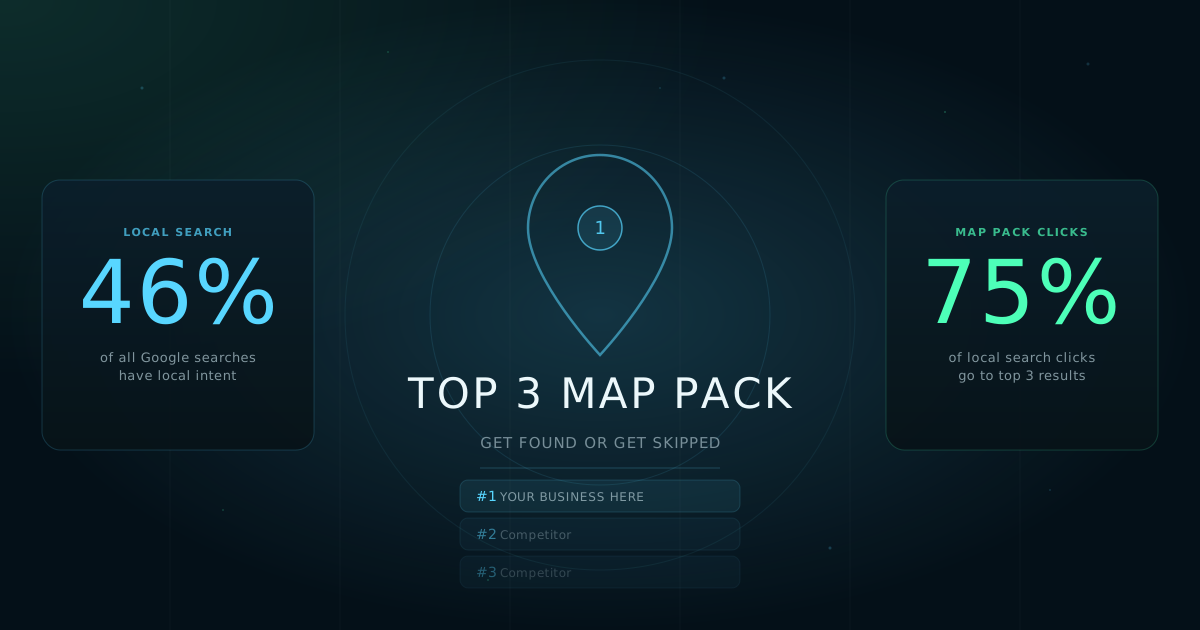
46% of all Google searches include local intent. When someone types "plumber near me" or "best pizza downtown," Google shows 3 local businesses above every other result. Those 3 spots, called the Map Pack, capture 75% of all clicks from that search.
If your business isn't in that group, most searchers will never reach you. They click one of those three, call, and move on.
What the Map Pack Is
The Map Pack is the block of 3 business listings that appears at the top of Google results for local searches. It shows your name, category, star rating, distance, hours, and a link to your website. There is a map on the right side.
Ranking here is separate from ranking in Google's standard web results. You can have a strong website and still not appear in the Map Pack. They use different signals.
How Google Picks the Top 3
Google uses three factors to rank Map Pack results.
Relevance is whether your business matches the search. Google reads your business category, the keywords in your listing name, and the content of your website to judge this. Choosing a precise primary category matters more than most business owners realize.
Distance is how close your business is to the searcher. You can't change your location, but you can make sure your address is listed accurately and consistently everywhere it appears online.
Prominence is how well-known your business appears to be across the web. This means your Google reviews, links to your website from other sites, and citations on directories. Of the three factors, prominence is the one you can do the most to improve.
Five Things That Move the Needle
1. Pick the right primary category. Go to your Google Business Profile and set your primary category to the most specific option available. "Plumber" ranks for more relevant searches than "Contractor." Google weighs this heavily for relevance matching.
2. Add photos consistently. Businesses with more than 100 photos get 520% more calls than those with fewer than 10. Start with 10 high-quality photos of your work, your space, and your team. Add two or three each month.
3. Get reviews and respond to all of them. More reviews raise your prominence score. Responding to every review, including negative ones, signals to Google that your listing is active. Ask every satisfied customer by name, the day the job is done.
4. Build local citations. List your business on Yelp, the BBB, Apple Maps, Bing Places, and 10 to 15 local or industry directories. Your name, address, and phone number must match exactly across every one of them. Even small differences hurt your ranking.
5. Put location keywords on your website. Your homepage title tag should include your primary service and city: "Electrician in Columbus | Davis Electric." Your website copy should mention your city, your neighborhoods, and your service area by name.

What Most Businesses Get Wrong
Most local businesses set up a Google Business Profile once and never touch it again. No new photos. No review responses. Hours not corrected after a remodel or seasonal change. Google interprets inactivity as a signal that the listing is stale, and it drops in rankings over time.
The businesses holding the top 3 spots treat their Google listing the same way a good business owner treats their storefront: kept current, stocked with fresh photos, and full of recent reviews. That consistency gap is where most of the ranking opportunity lives.
If you're not appearing in the Map Pack for your core service in your city, the checklist above covers every factor that moves you there. None of it requires paid ads. It requires setting up the right signals and keeping them fresh.
Sources
- BrightLocal. "Local Consumer Review Survey." brightlocal.com
- Moz. "Local Search Ranking Factors." moz.com
- Google. "Improve your local ranking on Google." support.google.com
- Search Engine Land. "Study: 75% of clicks in local SERPs go to the Map Pack." searchengineland.com
- Google Business Profile. "Add photos to your Business Profile." support.google.com