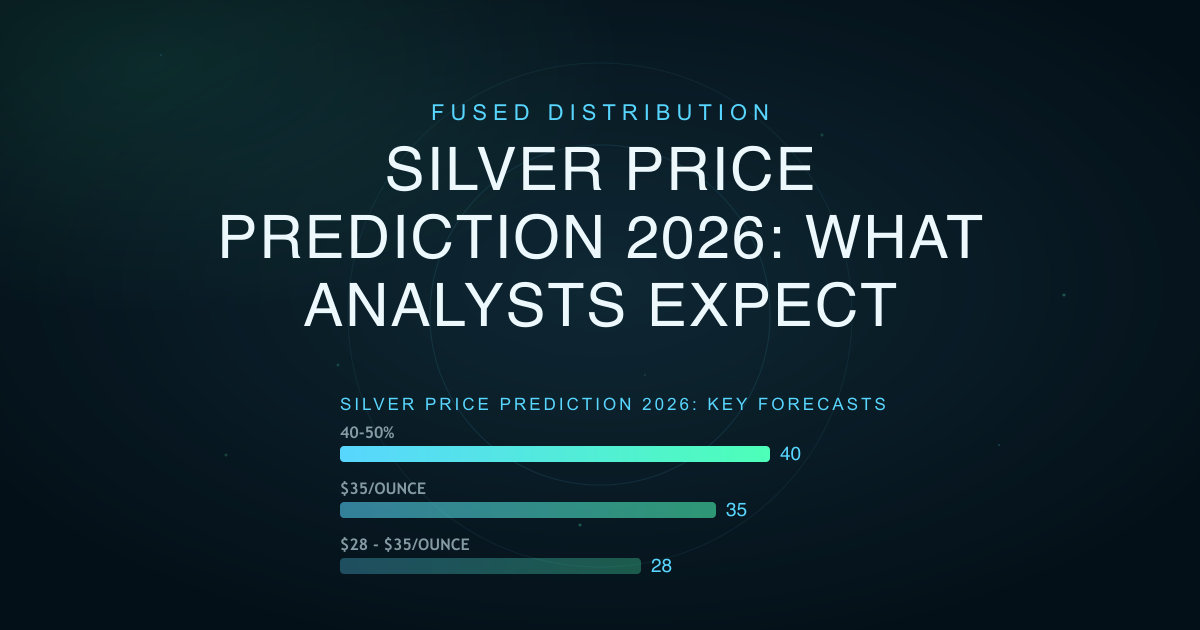
Correction dated July 29, 2026: An earlier version of this article used a July 2024 price, linked to source-prompt text instead of a valid page, and presented an unsupported $35 per ounce inflation scenario. Those claims have been removed. This version uses dated 2026 market data and links directly to the underlying sources.
Silver was $58.13 per troy ounce in Fused Distribution's cached daily spot snapshot on July 29, 2026. That is a point-in-time market observation, not a forecast. The most useful way to read a silver outlook is to separate today's price, an analyst's annual-average forecast, and an analyst's high-low range. They answer different questions and should never be plotted as if they are the same measure.
What Current Analyst Forecasts Actually Say
The LBMA 2026 Precious Metals Forecast Survey publishes named analysts' expected annual averages and trading ranges. The forecasts vary widely, which is itself important information about uncertainty.
LBMA's 2026 survey lists LBBW's annual-average forecast at $63.20 per ounce.
LBMA's 2026 survey lists MKS PAMP's annual-average forecast at $65.00 per ounce.
LBMA's 2026 survey lists LSEG Metals Research's annual-average forecast at $69.00 per ounce.
LBMA's 2026 survey lists UBS's annual-average forecast at $78.80 per ounce.
LBMA's 2026 survey lists Metals Focus's annual-average forecast at $83.00 per ounce.
These are annual averages, not promises that silver will finish 2026 at those prices. A volatile market can trade above and below an annual average many times.
Why a $35 Inflation Target Was Misleading
The previous statement that higher inflation could push silver above $35 per ounce no longer made sense after silver had already traded far above that level. It also oversimplified the relationship between inflation and precious metals.
Inflation can increase interest in hard assets, but the policy response matters. If inflation leads to higher interest rates and a stronger dollar, the opportunity cost of holding a non-yielding metal can rise. If real yields fall or policy uncertainty increases, investment demand can strengthen. No single inflation reading produces a defensible silver price target by itself.
For the mechanics behind these forces, see What Moves Silver Price Up and Down and How to Track Silver Price Daily.
The 2026 Market Has Already Been Extremely Volatile
The LBMA Q2 2026 market report says silver began the quarter at $74.870 and ended June at $58.795, a 21.47% decline. That path shows why a single target without a time period can mislead readers.
The World Bank's June 2026 precious-metals update reports that silver rose sharply in the first quarter and then declined in the second quarter. Its outlook expects silver's 2026 annual price level to remain well above 2025, while also emphasizing large upside and downside risks.
Supply and Demand Still Matter
The Silver Institute's 2026 outlook expects a sixth consecutive annual market deficit. It forecasts physical investment to rise while industrial fabrication, jewelry, and silverware demand soften at high prices.
That combination cuts both ways. Tight supply and investment demand can support prices. High prices can also encourage recycling, substitution, and reduced consumption. A credible forecast should show both mechanisms instead of presenting only a bullish case.
How to Use a Silver Forecast
Use forecasts as scenarios for planning, not as purchase instructions.
- Check the measure. Is the number a spot price, annual average, year-end target, or intraday high?
- Check the date. A market forecast becomes stale quickly after a large move.
- Check the source. Follow the link to the named analyst or institution, not a search result or unattributed summary.
- Check the range. A wide range communicates uncertainty better than one precise target.
- Check your own costs. Physical silver includes dealer premiums, spreads, storage, and possible taxes that a spot-price forecast does not capture.
Bottom Line
As of July 29, 2026, silver's $58.13 spot snapshot is already well above the obsolete $35 scenario in the earlier version of this article. Selected LBMA annual-average forecasts span $63.20 through $83.00 per ounce, and individual analysts publish much wider trading ranges. The honest conclusion is not that one number will be correct. It is that silver remains highly volatile and sensitive to investment flows, monetary policy, physical supply, and price-sensitive industrial demand.
This article is educational and is not individualized financial advice.
Sources
- LBMA 2026 Precious Metals Forecast Survey
- LBMA Precious Metals Market Report: Q2 2026
- World Bank: Precious metals retreat from record highs
- Silver Institute: 2026 market outlook
Related
- Why Silver Price Dropped This Month
- Silver Price History and Long-Term Trends
- Silver Supply Shortage: What It Means for Prices
Read next: Why Silver Price Dropped This Month