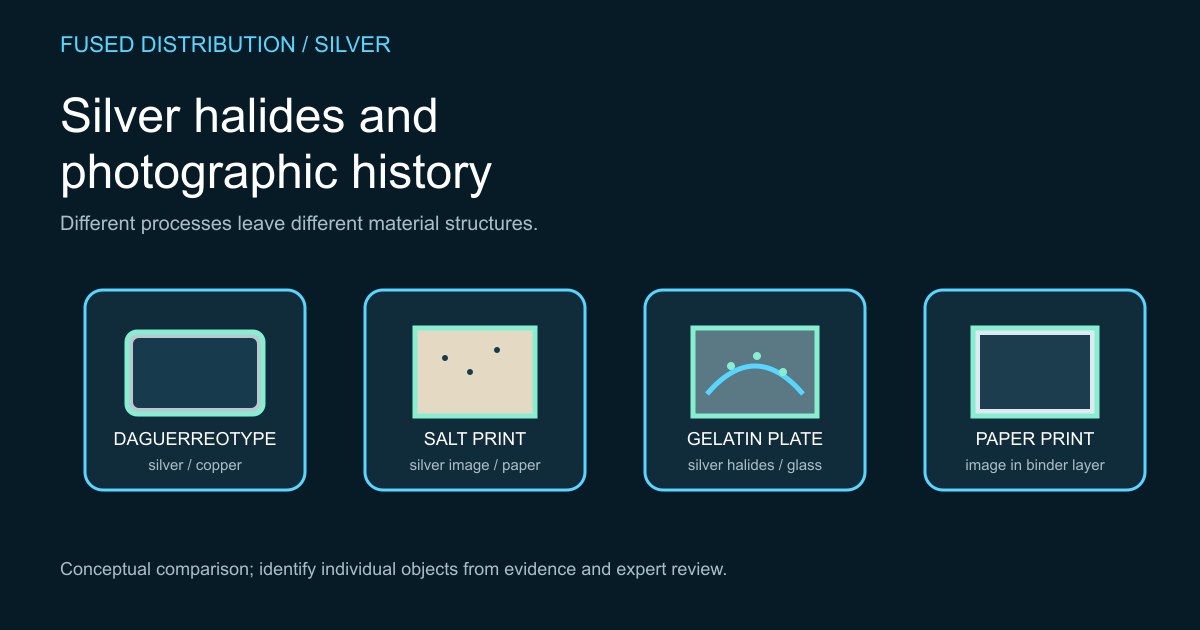
Daguerreotype → Image on silver-coated copper
Salted paper print → Silver image on paper
Gelatin dry plate → Silver halides in gelatin on glass
Silver compounds helped make early photography possible, but there was never just one “silver process.” The material, support, and way an image formed changed over time. A daguerreotype is a direct image on a silver-coated copper plate. Later processes used light-sensitive silver salts on paper or glass, often with a negative that could produce multiple prints.
That distinction matters when reading a family photograph, museum label, or conservation note. “Silver photograph” can describe different objects with different structures and care needs. The date and process name are clues, not substitutes for examining the object.
The daguerreotype made a direct image
Louis-Jacques-Mandé Daguerre’s process was announced publicly in 1839. A daguerreotype is made on a copper sheet coated with silver, and it forms a direct positive image without a separate negative. The Library of Congress describes the result as highly detailed. Because each plate is a unique camera-exposed image, it does not behave like a paper print made from a reusable negative.
An object identified as a daguerreotype should therefore not be casually described as a silver print on paper. Its metal support and image formation are central parts of what it is. The process name also does not tell you the exact condition or treatment history of a particular plate.
Paper and glass introduced other silver processes
Early paper printing included salted-paper prints, made by treating paper with sodium chloride and silver nitrate, then exposing it in contact with a negative. In the nineteenth century, the wet-plate collodion process placed light-sensitive chemicals on glass. It supported negatives as well as formats such as ambrotypes and tintypes, which had their own construction and appearance. These are related chapters in photographic history, but they are not interchangeable object types.
Later in the century, gelatin dry plates offered photographers glass already coated with an emulsion containing silver halides suspended in gelatin. The Smithsonian Institution Archives describes these plates as faster than wet collodion plates, allowing shorter exposures. Gelatin silver papers then became common for black-and-white prints. In these materials, the silver image is part of a layered object rather than a silver-coated plate.
Identify the process before drawing conclusions
When you are trying to identify an old photograph, record what can be observed: support, dimensions, surface appearance, mounting, inscriptions, and any label already attached to it. Keep those observations separate from a process identification. A paper support may narrow the possibilities, while a plate, negative, or print may point to a different process. A scan alone can hide important physical details.
Use a trusted collection or conservation reference to compare the object with documented process descriptions. Our guides to daguerreotypes and early photographic processes explain two historical examples. Do not infer a precise date from appearance alone, and do not clean or test an uncertain photograph as an identification shortcut. The Library of Congress notes that environmental conditions can damage silver images and cause fading or discoloration. For a valuable or fragile object, ask a photograph conservator before handling or treatment.
Keep the name and the object together
A useful catalog note names the proposed process, the evidence for that identification, and the remaining uncertainty. For example: “Paper print; gelatin silver process is a possibility; identification not confirmed.” This is more informative than recording only “black-and-white photo.” If a museum record or family inscription supplies the process name, note that source rather than presenting it as your own examination.
The history of silver photography is a sequence of distinct solutions: a direct image on a plated metal sheet, silver-based paper printing, glass negatives, and gelatin emulsions. Which process name would you want beside a photograph in your family archive, and what evidence would make you trust that identification?
Related
Read next: Explore early photography processes.
Sources
The process descriptions below identify common historical forms. They are not a method for diagnosing an individual photograph.
- The Daguerreotype Medium, Library of Congress
- Civil War Photographs: New Technologies and New Uses, Library of Congress
- There will always be a photography, Smithsonian Institution Archives
- Care, Handling, and Storage of Photographs, Library of Congress
Original publication was planned for October 6, 2026. Repaired for actual publication October 8, 2026; it remains unpublished until package review and approval.