Moving money from an employer retirement plan into a self directed IRA that can hold silver involves several separate decisions. A rollover can change the account custodian, the available investments, the fees, and the way the assets are stored. It is a paperwork process with tax consequences, so this guide is an educational checklist. Ask the 401(k) administrator, receiving custodian, and a qualified tax professional to confirm the details for your situation.
Start with the 401(k) plan rules
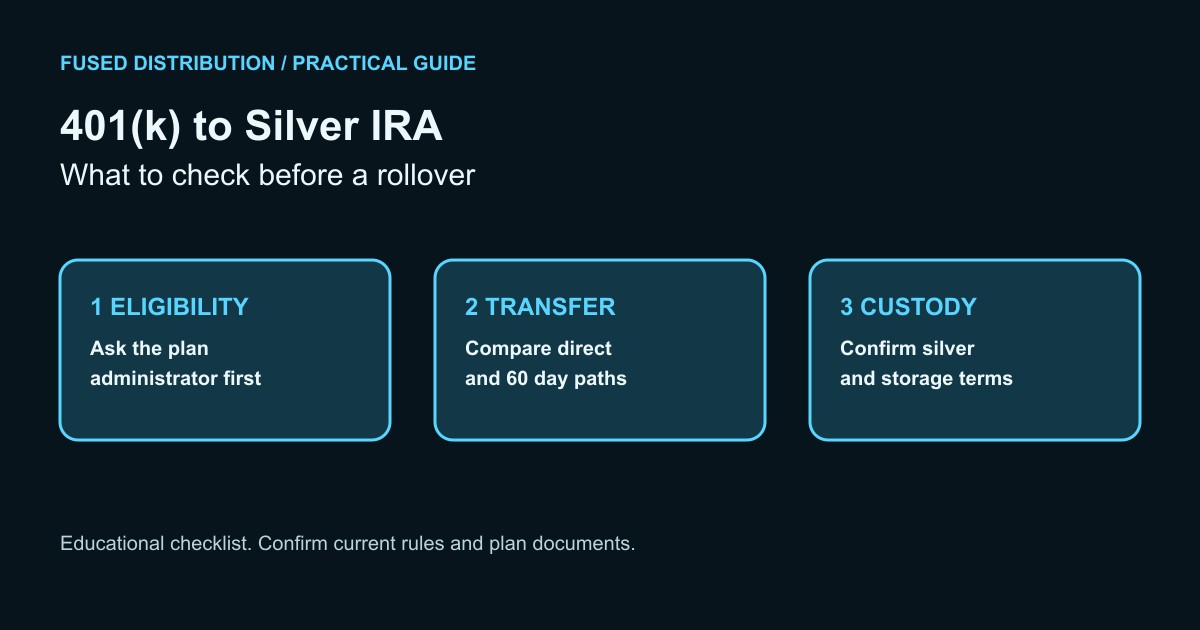
Do not begin with a dealer’s product list. Begin with the plan administrator. Ask whether your balance is eligible for a distribution or rollover now. Eligibility can depend on whether you have left the employer, reached a plan age, or meet another plan condition. A current employer plan may have distribution limits even when an IRA custodian is ready to open an account.
Request the plan’s rollover instructions and the tax notice for an eligible distribution. Confirm whether the account contains pretax funds, designated Roth funds, after tax contributions, employer stock, or a plan loan. Those categories can change the destination account and reporting. If you have a loan or an offset, ask how the plan will treat it before signing a distribution request. Moving pretax plan money to a Roth IRA generally creates taxable conversion income; a direct rollover does not make that conversion tax free. Required minimum distributions and certain other payments cannot be rolled over. Confirm both the eligible amount and receiving account type.
You may have several choices, including leaving money in the old plan, using a new employer plan if it accepts rollovers, or moving eligible money to an IRA. Compare the plan’s investment menu and fees with the proposed IRA costs. A silver IRA is not automatically a better retirement account because it holds a tangible asset.
Direct rollover versus a 60 day rollover
A direct rollover generally sends the money from the 401(k) trustee to the receiving IRA trustee. Ask the plan to make the check payable to the receiving custodian for your benefit, or use the electronic transfer instructions supplied by both institutions. Because the distribution is paid directly to an eligible plan or IRA, the IRS says mandatory 20 percent federal withholding generally does not apply.
An indirect rollover sends the distribution to you first. The IRS generally gives you 60 days from receipt to deposit eligible funds into another plan or IRA. An eligible rollover distribution from an employer plan paid to you generally has 20 percent federal income tax withholding on its taxable portion. To roll over the full distribution, you must deposit the amount received plus the amount withheld from other funds. If you deposit only the check, the withheld amount can become taxable and may also face an additional tax unless an exception applies.
For example, a $40,000 plan distribution paid to you might arrive with $8,000 withheld and a $32,000 check. A full rollover would require depositing $40,000, not only $32,000. This is an illustration of the withholding mechanics, not a prediction of your tax bill. A direct rollover avoids having to replace that withholding from personal cash.
The 60 day deadline is not a planning cushion for an uncertain transfer. Before requesting an indirect rollover, identify the receiving account, confirm its contribution instructions, and ask when it will credit the deposit. Keep the distribution statement, check copy, deposit receipt, and confirmation. If a deadline problem occurs, IRS relief may be limited to recognized circumstances and is not automatic.
Do not confuse the one rollover rule
The one rollover per year rule generally applies to a distribution from an IRA rolled to another IRA. It does not prohibit a qualified employer plan to IRA rollover, and it does not apply to a trustee to trustee transfer. The categories are easy to mix up, so describe the exact source and destination to the plan administrator and custodian. Do not use a broad internet summary as a substitute for the transaction coding on your forms.
Select the receiving custodian before moving cash
The receiving account must be an IRA arrangement that permits the proposed precious metals investment. Ask the custodian for its account agreement, fee schedule, eligible asset list, distribution process, and storage agreement. Compare setup, annual administration, transaction, dealer, shipping, and storage costs. Ask whether storage is segregated or commingled, how insurance is described, and which party maintains transaction records.
The custodian comparison in this silver IRA guide can help you build questions, but its fee examples and provider information still require current confirmation. A custodian’s willingness to open an account does not by itself verify that a rollover is eligible or that a particular product qualifies.
Confirm the silver and storage arrangement
The tax rules for IRAs do not treat every silver object as an eligible investment. The IRS identifies exceptions for certain coins and qualifying bullion; collectible treatment and trustee possession requirements need careful review. Ask the custodian to approve the exact coin or bar, including its form, fineness, weight, and source, before ordering it. Do not infer eligibility from a generic description such as “one ounce” or “.999 silver.” The purchase must satisfy the applicable tax rules as well as the custodian’s acceptance policy. A custodian’s product list does not override the law.
Retirement account metals are held through the trustee or custodian and an approved storage arrangement. A home safe, personal vault, or informal box does not become compliant merely because the owner calls it an IRA depository. Ask where the metal will be held, who has possession, how inventory is reconciled, and how a future distribution will be handled. The overview Can You Put Physical Silver in an IRA? covers the account and storage distinction; use the custodian’s current documents for the transaction.
Keep the transaction sequence simple
Open and fund the receiving IRA before directing a purchase. Give the 401(k) administrator the exact receiving registration and mailing or wire instructions. Check that the check is payable to the trustee or custodian rather than to you personally. Notify the custodian when the transfer is sent, then confirm the amount received and the tax year in which the plan reports it.
Only after the cash is credited should you review a dealer quote and the custodian’s purchase authorization. Save the quote, invoice, premium, shipping charge, wire receipt, order confirmation, and custody record. A lower advertised metal price may not be a lower total cost after dealer spreads, account charges, storage, and shipping.
If you later take a distribution, ask the custodian whether you will receive cash or the metal and how the distribution will be reported. The account’s tax treatment and your age, basis, type of IRA, and other facts matter. Do not assume a future in kind delivery is tax free or that a sale inside the account creates the same tax event as a personal sale.
Use this pre transfer checklist
- Ask the 401(k) administrator whether this exact balance and distribution are eligible.
- Identify pretax, Roth, after tax, stock, and loan components.
- Compare leaving the plan, a new employer plan, and an IRA.
- Prefer a direct trustee to trustee rollover when it fits the plan and IRA.
- If considering a 60 day rollover, reserve funds to replace any 20 percent withholding.
- Confirm that the one rollover per year rule actually applies to the proposed transaction.
- Read the receiving custodian’s agreement, fees, approved asset list, and storage terms.
- Get written approval for the exact silver before ordering.
- Retain every form, statement, receipt, and custody record.
- Ask a tax professional to review the transaction before requesting the distribution.
The IRS explains rollover timing, withholding, and the one rollover per year rule in its rollover guidance, Publication 590-A, and termination of employment guidance. Rules and plan documents can change, so check the current versions when you act.