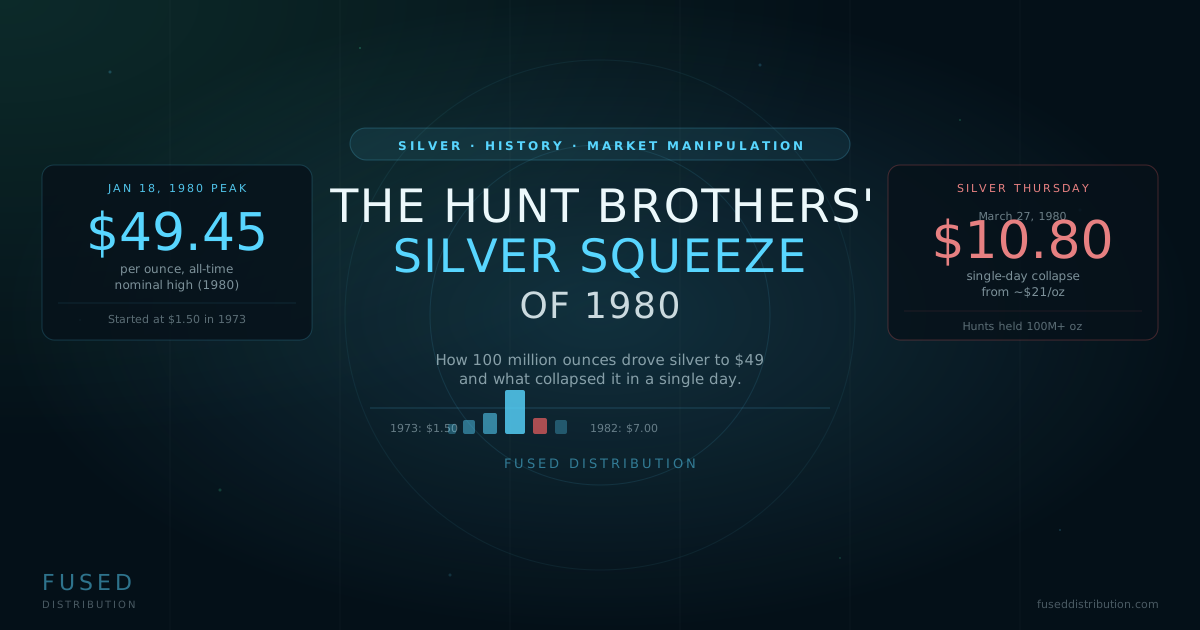
In January 1980, silver hit $49.45 per ounce. It had started the decade at about $1.50. The commodity didn't get there because of new industrial demand or a currency crisis. Two brothers from a Texas oil family accumulated more than 100 million ounces of the metal and drove prices up 33 times in seven years. Then the market authorities changed the rules mid-game, and the price collapsed. On a single day in March 1980, known as Silver Thursday, silver fell from $21 to $10.80. The brothers eventually lost more than a billion dollars.
This is the most dramatic episode in silver's modern history. It's also one of the clearest examples of what happens when a speculative position exceeds the market's ability to sustain it. For anyone buying physical silver today, the Hunt story is worth understanding not because it repeats literally, but because the forces it revealed are still in the market.
The story also touches on questions about what actually moves the silver spot price and whether those forces are ever fully in a buyer's control. The short answer, as the Hunts found: they're not.
Who the Hunt Brothers Were
Nelson Bunker Hunt and William Herbert Hunt were sons of H.L. Hunt, a Texas oil billionaire who was at one point considered the wealthiest private citizen in the United States. Nelson Bunker in particular had a pattern of large-scale commodity speculation. He had previously tried to corner the soybean market in 1977, an attempt the CFTC blocked.
The brothers weren't reckless gamblers. They were ideologically motivated. Both men were convinced that paper money was going to collapse, that inflation would destroy dollar-denominated assets, and that hard commodities were the only real store of value. They weren't entirely wrong about the inflation part. The 1970s were marked by serious inflation, an oil shock, and a weakening dollar. Their mistake was believing they could force the outcome they expected.
They started accumulating silver futures contracts and physical silver in 1973, when the price was around $1.50 per ounce. Over the following years, they brought in Arab partners, including members of a Saudi royal family and a Libyan connection, to pool capital. By 1979, the Hunt family and their partners controlled an estimated 100 million ounces through futures contracts and physical holdings, which represented roughly one-third of the world's non-government silver supply.
How the Squeeze Actually Worked
A market corner works through control of supply and demand simultaneously. If you own enough of a commodity and also hold a large number of futures contracts requiring delivery of that same commodity, sellers of those contracts face a squeeze. They've promised to deliver silver they can't easily acquire because you own most of what's available. They're forced to buy from you at whatever price you set, or default on their contracts.
In 1979, the Hunts' futures positions were so large that traders who had sold silver contracts short were scrambling to cover. The COMEX had a limit of 500 futures contracts per trader, but the Hunts were holding positions through multiple accounts and entities to circumvent this. Prices went from $6 per ounce in early 1979 to $49.45 on January 18, 1980. A gain of over 700 percent in twelve months.
During this run, silver jewelry and silverware started showing up at pawn shops across the country. Families were melting down heirlooms. Tiffany ran a full-page advertisement in the New York Times criticizing what the Hunts were doing to silver markets. The price distortion was visible to everyone.
Silver Thursday: The Day the Position Collapsed
The exchange and regulators moved against the Hunts in January 1980, the same month prices peaked. COMEX enacted "Silver Rule 7," which restricted new futures contracts to liquidation only. Traders could sell silver futures but could not open new long positions. This removed the buying pressure that had been sustaining the price run.
Prices began falling. The Hunts held their physical silver and refused to sell, but their futures positions were hemorrhaging. Futures require margin, and falling prices triggered margin calls, meaning they had to post more cash or have their positions liquidated. By March, the cash demands were enormous.
On March 27, 1980, the Hunt brothers could not meet a $135 million margin call from Bache Group, their primary brokerage. Bache was forced to liquidate their silver positions on the open market. The resulting avalanche of selling drove silver from roughly $21 to $10.80 in a single day. Bache itself nearly failed. The Federal Reserve coordinated an emergency $1.1 billion loan from a consortium of banks to prevent a broader financial collapse.
Nelson and William Herbert Hunt avoided criminal prosecution but faced years of civil litigation. In 1989, they settled charges brought by the CFTC and a Peruvian mining company named Minpeco that had suffered losses betting on lower silver prices. The combined settlement totaled $134 million. Nelson Hunt filed for personal bankruptcy in 1988, listing $2.5 billion in liabilities.
What This Means for Silver Buyers Today
The Hunt episode isn't ancient history detached from today's market. It has direct implications for anyone holding physical silver or watching silver prices move.
Position limits exist because of the Hunts. The CFTC tightened futures position limits significantly after 1980. Today, large speculative positions that might distort silver prices face regulatory constraints that didn't fully exist before the squeeze. This doesn't make the market immune to manipulation, but it makes the Hunt-style corner considerably harder to execute.
Price spikes built on paper leverage collapse differently than organic price moves. Silver's rise from 1973 to 1980 was artificial in the sense that it was driven by leveraged futures accumulation, not by genuine demand outpacing supply. When the leverage unwound, prices fell further and faster than they had risen on fundamentals alone. Contrast this with silver's move from roughly $5 in 2003 to $49 in April 2011, which had real industrial demand growth underneath it. That peak was also followed by a sharp correction, but the underlying demand story remained intact. Understanding the real drivers of silver spot price helps you separate leverage-driven spikes from durable price support.
Physical holders were insulated from the worst of it. Investors who held physical silver at the 1980 peak took losses when the price corrected, but they weren't wiped out the way futures traders were. Bache clients with leveraged futures positions faced margin calls they couldn't meet. Someone who bought physical silver coins had a loss on paper but still held the metal. This is one reason most conservative silver buyers keep physical as the core position and treat futures or ETF exposure as a smaller, separate allocation.
The question of how to size a silver position given its volatility history is covered in more detail in the silver portfolio allocation guide, which includes a practical framework for matching silver weight to your broader financial picture.
The reset wasn't permanent. Silver priced below $10 after the 1980 collapse and traded in a range of $4 to $10 for most of the next two decades. By the 2000s, with genuine industrial demand growth from electronics, the price base had shifted higher. Silver's 2011 high of $49 came 31 years after the Hunt peak and had nothing to do with the Hunts. The metal's story didn't end in 1980. It just reset to a level based on actual supply and demand.
Frequently Asked Questions
Read next: How Much Silver Should You Own? A Practical Allocation Guide
Sources
- CFTC, "In the Matter of Nelson Bunker Hunt, William Herbert Hunt," Commodity Futures Trading Commission enforcement records, 1989
- Stephen Fay, "Beyond Greed: The Hunt Family's Bold Attempt to Corner the Silver Market," Viking Press, 1982
- London Bullion Market Association, historical silver fixing prices, retrieved 2026-06-06, lbma.org.uk
- U.S. Commodity Futures Trading Commission, "A Study of the Silver Market," 1981
- New York Times, "Silver Thursday: How Two Texas Brothers Nearly Broke the Market," March 1980 archive
- Federal Reserve Bank of New York, emergency loan coordination records, March 1980