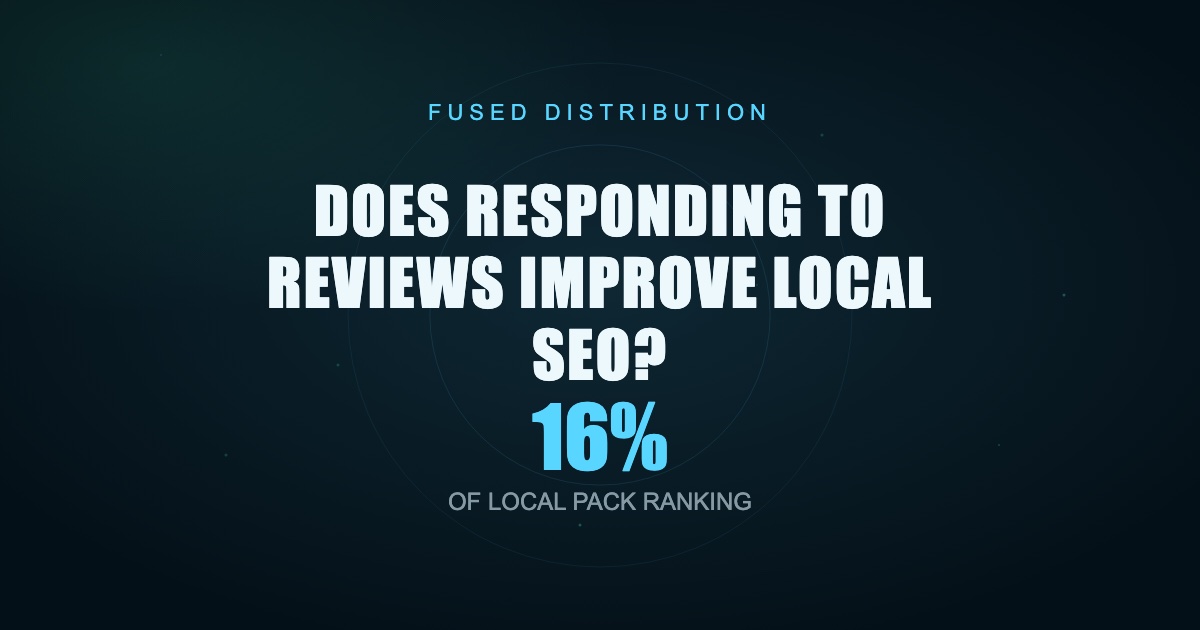
Yes. Responding to reviews directly improves your local SEO, and the gap between businesses that do it and those that don't is measurable. Google treats your review responses as proof that your business is active and customer-focused. That signal feeds into how prominently you appear in local search results.
Photo by cottonbro studio on Pexels
This post covers what actually happens when you respond, what to write, and how to build a repeatable system without spending hours on it every week.
Key Takeaways - Review signals, including owner responses, account for roughly 16% of local pack ranking factors, the second most influential category after Google Business Profile optimization (Source: Whitespark Local Search Ranking Factors 2026) - 89% of consumers expect you to respond to their review (Source: BrightLocal Local Consumer Review Survey 2026) - Businesses that respond to all reviews are seen as trustworthy by 80% of consumers, compared to 45% for those that only respond to positive ones (Source: BrightLocal Local Consumer Review Survey 2026)
Photo by Faruk Tokluoğlu on Pexels
How Google Uses Your Review Responses as a Ranking Signal
Google is explicit about this. Its own Business Profile help documentation states that responding to reviews shows you value customer feedback, and that more reviews and positive ratings can help your business's local ranking (Source: Google Business Profile Help, Tips to Improve Your Local Ranking). Review engagement falls under what Google calls "prominence," one of its three core local ranking factors.
Review signals as a whole, which include volume, rating, recency, keywords in reviews, and owner responses, account for approximately 16% of local pack ranking factors (Source: Whitespark Local Search Ranking Factors 2026, published November 2025). That makes them the second most influential signal category, behind only Google Business Profile optimization itself.
When you leave a review unanswered, you're leaving a ranking signal empty. Google's algorithm notices the absence of engagement.
Your response also gives you a natural place to include language that mirrors what customers search for. Someone writes a review about your "furnace repair in Columbus." You reply, thanking them and mentioning that your team handles furnace repairs across Columbus and surrounding areas. That reply becomes indexed content. It ties your business name to specific services and locations in a way a static business description can't replicate.
What the Numbers Say About Responding to Reviews
The consumer expectation data here is clear, and it should change how you think about reviews.
In 2026, BrightLocal found that 89% of consumers expect business owners to respond to reviews (Source: BrightLocal Local Consumer Review Survey 2026). Only 7% say they expect no response at all. That means the overwhelming majority of people who leave a review, or read reviews before choosing a business, are watching to see if you reply.
The trust gap between businesses that respond and those that don't is significant. According to the BrightLocal Local Consumer Review Survey 2026, 80% of consumers say they're likely to use a business that responds to all of its reviews, compared to just 45% who say the same for businesses that only respond to positive reviews. Responding to negative reviews isn't optional if you want people to trust you. It's part of what makes you look like a real, accountable business.
A separate study reinforces the conversion angle. According to SOCi's 2025 Consumer Behavior Index, which surveyed over 1,000 US consumers, 65% of people say they're more likely to choose a business that actively responds to reviews. That's a meaningful lift in customer acquisition from one simple operational habit.
What we've seen: When we audit new clients' Google Business Profiles, the ones with zero review responses almost always have lower map pack placement than competitors with similar ratings and fewer total reviews. Engagement, not just volume, is what moves the needle.
What to Write in Every Review Response
Short and specific beats long and generic every time. Here are three response frameworks your team can use and adapt.
For a positive review:
"Thank you for sharing this, [Name]. We're glad the [specific service] worked out well for you. If you ever need us again for [related service] in [city], don't hesitate to reach out."
That response does three things. It acknowledges the specific customer. It names the service. It mentions the city. All three reinforce your local relevance without sounding forced.
For a neutral or mixed review:
"Thanks for the honest feedback, [Name]. We're sorry [specific issue] wasn't up to your expectations. We'd like to make it right. Please call us at [phone] or reply here and we'll sort it out."
This shows accountability publicly and moves the conversation offline. Potential customers watching the exchange see that you respond quickly and take problems seriously.
For a negative review:
"[Name], thank you for letting us know. This isn't the experience we aim to deliver, and we'd like to address it directly. Please reach out to [name or email or phone] so we can work through this."
Keep it short. Don't argue. Don't paste in legal-sounding language. A calm, brief reply signals confidence, not defensiveness.
Across all three, notice the pattern: name the service, mention the location where relevant, stay human, and stay brief. Two or three sentences is enough.
One thing most small businesses miss: the review response is also read by people who haven't left a review yet. They're evaluating whether this is a business worth trusting. Your response to someone else's review is, functionally, a public statement about how you treat customers. Write it with that audience in mind.
How Fast Do You Need to Respond?
Faster than most business owners expect. In 2026, 19% of consumers now expect a same-day response to their review, up sharply from 6% in 2025, and 81% expect a reply within one week (Source: BrightLocal Local Consumer Review Survey 2026). Consumer expectations around response time have accelerated dramatically in a single year.
For most small businesses, a 24-to-48 hour target is realistic and meets the expectations of the large majority of reviewers. Same-day response is best for negative reviews, where a fast reply can reduce frustration before it escalates.
Here's a simple approach. Set a recurring calendar reminder to check your Google Business Profile reviews twice a week, on Monday morning and Thursday afternoon. That cadence keeps your response lag under three days, which falls well within the window most consumers find acceptable.
If you have staff, assign review response as a named task with a clear owner. "Check and respond to reviews" sitting on no one's to-do list means it never happens.
Google Business Profile also has a mobile app. Turn on notifications for new reviews. You'll get an alert when a review comes in and can reply from your phone in under two minutes.
Building a Response System That Doesn't Take Over Your Day
The businesses that consistently respond to reviews aren't doing it because they have spare time. They've turned it into a repeatable habit with a few basic guardrails.
Start with a template library. Write out five to eight base responses covering common review types: glowing praise, general thanks, service-specific feedback, minor complaints, and serious complaints. Store them somewhere your whole team can access. A shared Google Doc or notes app works fine. Responses should always be personalized before sending, but starting from a template cuts response time from five minutes to under one.
Next, set review monitoring up so it finds you, instead of you hunting for it. Google Business Profile notifications handle Google reviews automatically. For Yelp, Facebook, and others, a free Google Alert for your business name, or a low-cost reputation management tool, can funnel all new reviews into a single inbox.
Finally, treat review response as a business practice, not a marketing task. When a customer calls to complain, you don't wait two weeks to reply. Reviews are the online version of that call. Treat them the same way.
The compounding effect is real. Businesses that respond consistently tend to generate more reviews over time, because the social signal that "this business actually reads and replies" encourages more customers to leave feedback. More reviews, with active responses, builds exactly the review signal cluster that Whitespark identifies as your second strongest local ranking driver.
If you haven't made review response a regular habit yet, this is one of the highest-impact adjustments you can make this week. No ad spend, no redesign, no technical knowledge required. Just consistent, thoughtful replies to what your customers are already writing about you. Start with the last five reviews you've received and respond to each one today.
Frequently Asked Questions
Does responding to negative reviews help SEO?
Yes. Responding to negative reviews signals to both Google and potential customers that you're engaged with your reputation. Review signals, including owner responses, make up approximately 16% of local pack ranking factors (Source: Whitespark Local Search Ranking Factors 2026). A calm, professional reply to a negative review can also convert undecided searchers who see how you handle problems.
How quickly should I respond to a Google review?
In 2026, 19% of consumers expect a same-day response and 81% expect a reply within one week (Source: BrightLocal Local Consumer Review Survey 2026). A 24-to-48 hour target is achievable for most small businesses and meets the expectations of the majority of reviewers. Negative reviews should be prioritized for same-day response where possible.
What keywords should I include in review responses?
Mention the specific service performed and the city or neighborhood where your business operates. If someone reviewed your "roof repair in Denver," a response that says "we're glad our roof repair team could help you out in Denver" naturally includes location and service keywords. Keep it conversational. Don't repeat keywords multiple times in the same reply.
Do review responses help on Google Maps specifically?
Yes. The local pack and Google Maps results draw from the same ranking signals. Review signals, which include your response rate and response quality, are part of Google's prominence score and directly influence your position in map-based search results.
How many reviews do I need to respond to?
All of them. According to BrightLocal's Local Consumer Review Survey 2026, 80% of consumers say they're likely to use a business that responds to all of its reviews, compared to just 45% for businesses that only respond to positive ones. Selectively responding signals that you're only interested in good news, which undermines trust.