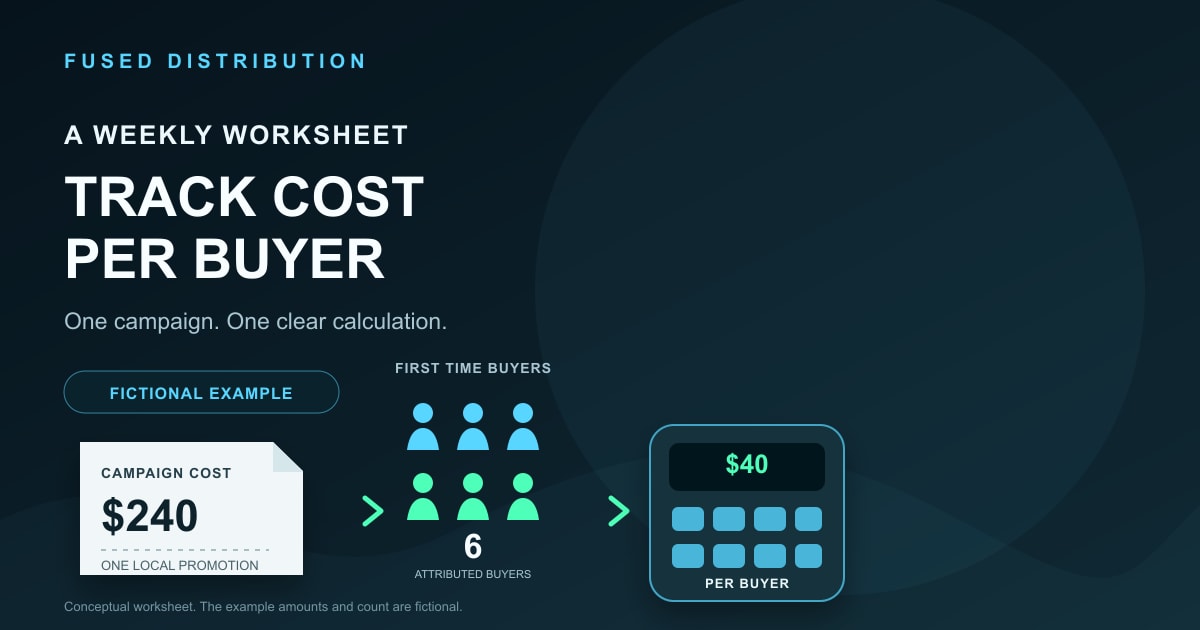
Local campaign cost → $240
First time buyers attributed → 6
Cost per new customer → $40
You can finish a busy week with a full calendar and still not know which marketing activity brought in a paying customer. A small weekly worksheet can connect one channel's cost with the first time buyers you can reasonably trace to it. The result is a customer acquisition cost estimate for that channel, not a grade for your whole business.
This article turns that idea into a repeatable five step check. You will choose a measurement window, list the costs you plan to count, record first time paying customers, divide cost by customers, and write down what remains uncertain. The example uses fictional numbers so the calculation is easy to follow. It is not a target to copy.
What a weekly check can tell you
Customer acquisition cost, often shortened to CAC, asks how much a defined effort cost for each new customer it brought in. SCORE uses a tactic level example in its sales and marketing planning guide: estimate the cost of a referral partner's effort, then compare it with the customers that effort produces. The useful unit is the campaign or channel you can describe, not an unexplained company wide total.
A weekly check can help you notice whether the cost of one defined campaign is changing. It can also show where your records are too vague to support a decision. It cannot prove that a social post, flyer, event, or referral caused a sale when a customer encountered several of them. It does not measure profit, customer satisfaction, repeat buying, or cash flow by itself.
The five step weekly worksheet
Step one: set the window and the customer definition
Write down the start and end dates. Use the same period for the costs and customer count. Then decide what counts as a new customer for your business. A first time paying customer is a useful starting point. A new inquiry, website visit, email signup, or quote request is not yet a paying customer.
The time between hearing about a business and buying can differ. If your sales usually take longer than one week, do not force every sale into the week it first appeared. Mark the result as preliminary, choose a follow up date, and update it when the buying decision is known. Keep the original period visible so that a later update does not quietly change the measurement.
Step two: choose one channel and list its costs
Start with a campaign you can name, such as one local event, a paid search campaign, a printed offer, or a referral arrangement. List the costs you intend to count. Depending on the effort, that could include the ad charge, printing, event fee, or a referral payment. Write the included items next to the result.
There is no single boundary that fits every business. Some owners will count only direct campaign expenses. Others may include staff time or production costs. Either choice can answer a useful question if you define it and use the same boundary when you compare periods. Do not compare one campaign's direct ad charge with another campaign's full cost and call the result like for like.
Keep each channel in its own row at first. Combining a referral event, a newsletter, and a paid ad into one total can hide which effort needs a closer look. The SCORE marketing plan guide recommends setting trackable goals and planning the cost to acquire a customer. Your worksheet gives those intentions a place to meet actual records.
Step three: count first time paying customers you can trace
Use the same customer definition you chose in step one. Ask new customers how they first heard about you. If a channel has a code or a dedicated link, record that too. The Small Business Administration describes asking customers where they learned about a business and using distinct codes or analytics to monitor results in its marketing budget guide.
Offer an unknown or not sure answer. A customer may have seen a post, heard from a friend, and searched for your business later. A forced guess creates a neat spreadsheet but weak evidence. Count a customer in a channel only when your rule supports that choice. Keep leads and paying customers separate so a rise in inquiries does not look like a rise in sales.
Step four: divide the channel cost by its attributed customers
Use this formula: For more on this, see How to Build Business Connections That Create Opportunities.
Channel cost for the chosen period ÷ first time paying customers attributed to that channel = estimated cost per acquired customer.
Keep the numerator and denominator in the same row. If you counted the full month of ad spending, do not divide by only the customers from one weekend. If you count a customer in more than one campaign, note that overlap rather than pretending the attribution is exact.
Step five: label the result before comparing it
Write the result beside the dates, channel, included costs, customer count, and any caveat. Compare it with the same channel measured in the same way during another period. Do not treat a difference as proof of cause if the offer, audience, season, or customer path also changed.
The SBA notes that some marketing methods, including word of mouth, are difficult to measure. Keep that uncertainty visible. A useful worksheet may say “three customers reported the event, two were unsure” instead of assigning every sale to the event. Consistency makes the record more useful; it does not turn an estimate into perfect attribution.
A fictional example, step by step
Suppose a shop spends $240 on one local promotion during a selected period. Six first time paying customers say that promotion brought them in. The arithmetic is $240 divided by 6, or $40 per attributed customer. These figures are made up for the example. They do not describe a real business and are not a recommended cost.
The worksheet should preserve more than the final $40. It should also show the dates, what the $240 includes, how “first time customer” was defined, and how the six customers were connected to the promotion. If two customers were unsure, record the known and uncertain counts separately. Do not move them into the promotion total just to make the result look complete.
If no new paying customers can be attributed during the window, do not divide by zero or write an invented cost per customer. Record “not measurable in this period,” then check whether the campaign had enough time to produce sales and whether the tracking question was asked consistently. That is a useful finding, even though it is not a dollar figure.
A one row record to reuse next week
For each channel, save a short record with:
- Channel or campaign name and measurement dates.
- Costs counted and costs left out.
- First time paying customers attributed, plus unknown responses.
- The calculation or “not measurable in this period.”
- The date you will revisit preliminary results.
- One question to investigate before changing the campaign.
This record helps you compare your own efforts without borrowing an unrelated industry average. The SBA's marketing and sales guide recommends tracking marketing costs and comparing them with generated revenue, while noting that some tactics are hard to measure. Keep the limits beside the numbers so a quick check does not carry more certainty than the records support.
Use the number as a prompt, not an automatic decision
A higher estimate can prompt questions: Did the campaign cost more? Did the customer count arrive later than usual? Did you include the same costs this time? A lower estimate can prompt a different question: did those customers buy, and did the campaign actually bring them in? Check the source records before cutting or increasing a budget.
Customer acquisition cost is one view of marketing. Pair it with the sales, margin, and repeat purchase information that fits your business before making a large decision. If those records are not ready, say so and improve the worksheet next week. A small record you can repeat honestly is more useful than a precise looking number built on guesses.
Follow Fused Distribution on Instagram and Facebook for more practical business growth ideas.
Related
- The One Number Every Small Business Should Check Weekly
- How to Build Business Connections That Create Opportunities
- Document Website Access for Google Business Profile
Read next: The One Number Every Small Business Should Check Weekly