Keep the reporting year separate from the edition → Look for changed definitions and coverage
Distinguish a revision from a new comparison → Explain uncertainty without making a forecast
A silver statistic can change between publications without the two documents describing different physical events. One release may use an estimate while a later edition incorporates a revised value. Start by identifying the measure, reporting period and edition. A changed number alone does not tell you why it changed.
This is a method for reading revisions, not an explanation for a particular market movement. The USGS Mineral Commodity Summaries collection provides annual editions and associated data. When comparing editions, preserve the original labels and footnotes rather than copying isolated numbers into a chart.
Keep the silver reporting year separate from the edition
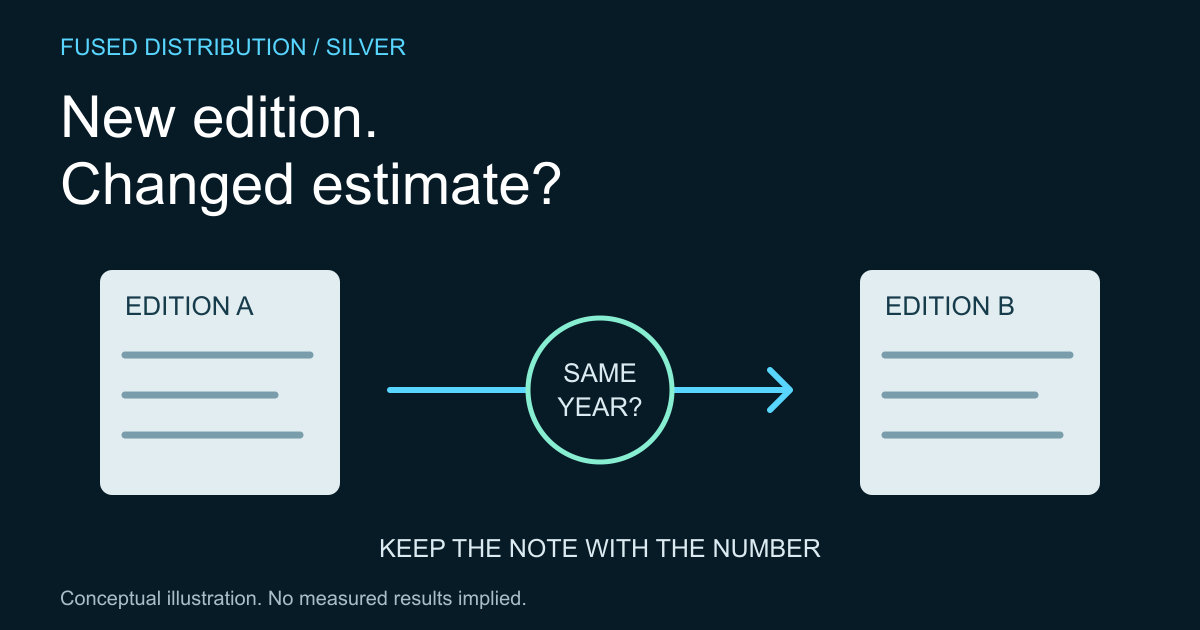
Write the publication date and the year measured in different fields. A document published in one year can describe activity in earlier years. Comparing the newest value visible in each document may accidentally compare different periods rather than a revision to the same period.
Use the USGS summary reading worksheet to record the source context. Keep a copy or stable link to each edition. If you cannot locate the original table, describe the comparison as incomplete instead of treating a quoted figure from another website as an equivalent source.
Look for changed definitions and coverage
Before interpreting the difference, compare the row label, geography, units and accompanying explanation. A change in coverage or classification can make two figures unsuitable for direct subtraction. Whether that happened in a particular publication must be established from its documentation, not assumed because a revision seems large.
Keep estimate markers and notes attached to each value. If a release explains a revision, summarize that explanation narrowly and link to it. If it gives no reason, say the reason was not established in your review. Do not invent a story about mines, demand or reporting delays to fill that gap.
Distinguish a revision from a new comparison
The same metal can appear in different statistical categories. Mine output, refinery output and other measures should not be substituted for one another. Our article on mine and refinery production explains how different stages can describe some of the same material. Definitions matter before combining totals.
Create a two column evidence sheet before calculating a percentage difference. Include source, edition, period, measure, unit and qualification. Only calculate a revision when those fields establish a meaningful comparison. Label the result as your calculation and preserve enough precision to reproduce it.
Explain uncertainty without making a forecast
A useful summary says which historical estimate changed, how the comparison was checked and what the publisher says about it. Keep the numerical observation separate from any interpretation. A revised quantity does not, by itself, establish a trading opportunity or a future silver price.
If you maintain a chart, date the update and keep the prior data file. Readers should be able to understand why a previously published point moved. For an unresolved discrepancy, pause the chart update or show the qualification clearly. An honest limit is more useful than a confident explanation without evidence.
Sources
- USGS Mineral Commodity Summaries. Source context is distinguished from the original practical method above.
Related
Read next: How to read a usgs silver commodity summary.