Free is one of the most powerful words in marketing. Not because it sounds appealing. Because the human brain treats zero price as a completely different category than any other price.
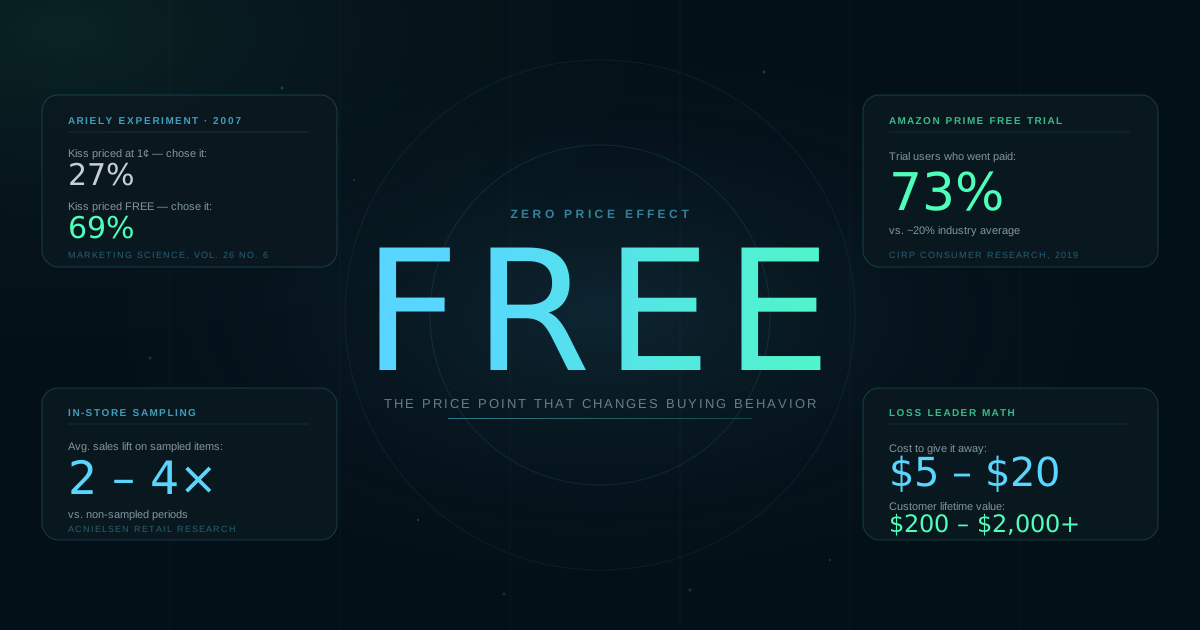
A Hershey Kiss for 1 cent is cheap. The same Kiss for free becomes irresistible, even to people who rationally know they are getting the same product. This is not a theory. Researchers documented it at an MIT cafeteria in 2007, and businesses have been building profitable customer bases on the same insight ever since.
Sources: Shampanier, Mazar & Ariely (2007); CIRP Consumer Research (2019); ACNielsen retail sampling data
The Science Behind "Free"
In 2007, Dan Ariely and his colleagues at MIT published a study in Marketing Science titled "Zero as a Special Price: The True Value of Free Products." They ran a simple experiment at a campus cafeteria offering two chocolates: a Lindt truffle for 15 cents and a Hershey Kiss for 1 cent. At those prices, 73% of people chose the truffle. The value was obvious.
Then they dropped both prices by exactly 1 cent. The truffle went to 14 cents. The Kiss became free. The relative price gap between the two stayed identical. But demand reversed. Suddenly 69% of people chose the Hershey Kiss. The truffle, still a better deal on paper, lost.
The researchers called this the zero price effect. When a product costs nothing, the mental calculation changes. You stop asking "is this worth it?" and start asking "why wouldn't I?" The perceived risk drops to zero. The decision becomes easy. Demand jumps far beyond what a simple price reduction would predict.
How the "Just Pay Shipping" Model Uses This
The direct-to-consumer advertising model built around free products runs on exactly this principle. You have seen the ads: get this free, just cover shipping. The company loses a few dollars per unit. The customer commits almost nothing.
What happens next is predictable. A person who pays $6 in shipping to get a free item is more qualified than someone who clicked a $30 ad. They spent money. They made a decision. They are interested. Now they have your product in their hands, which puts you in a fundamentally different relationship than any ad could create.
The model works best when the free item genuinely represents your product. It is not a cheap gift or a discount code. It is your actual product or service, given away to remove the one barrier that stops most first purchases: the cost of trying something unfamiliar. Once someone has used what you offer, reordering becomes obvious. The second purchase converts at a much higher rate than the first.
What the Case Studies Show
Costco's in-store sampling is one of the most studied tactics in retail. Free samples consistently produce 2 to 4 times normal sales on sampled items during sampling periods. The mechanism is simple: remove the risk of a bad purchase, let the product speak for itself, and conversion follows at a rate no advertisement can match.
In 1903, King Gillette started distributing razors nearly for free through partnerships with banks and employers. The product he made real money on was replacement blades. Over a century later, every subscription box company, SaaS business, and free trial offer is running the same model. Give the entry point, profit from what follows.
Amazon offers a 30-day free trial for Prime. Consumer Intelligence Research Partners found that roughly 73% of trial members convert to paid subscribers. Standard software free trials convert at 15 to 25 percent. The gap comes from Amazon delivering immediate, tangible value during the trial rather than just a limited product demo.
Dollar Shave Club built its subscriber base by making the first box extremely cheap, sometimes as low as $1 plus shipping. On paper, the economics of that first transaction look bad. They grew to 3.2 million subscribers and sold to Unilever for $1 billion in 2016. The math worked because of what each subscriber was worth over time, not what they paid on day one.
The Math Behind Giving It Away
Free offer economics only work if the customer is worth more than the cost of acquiring them. If it costs $10 to ship someone a free product and the average customer who came through that offer spends $300 over two years, you made $290 on a transaction that initially looked like a loss.
The number that matters is customer lifetime value. Gillette understood this before the term existed. Amazon understood it when they priced Prime below cost for years to build subscriber habits. If your business has customers who come back, the acquisition math usually works in your favor. The businesses that never figure this out are the ones treating every first transaction as the whole relationship.
What This Looks Like for Your Business
You do not need to give away your most expensive product. You need to give away something with real perceived value that gets your product or service into someone's hands before they have committed to anything.
For a physical product business, that might be a sample or a discounted first order that breaks even. For a service business, it is a free audit, an initial consultation, or a short trial engagement. For a subscription or membership, it is a free period with no risk and a clear sense of what you actually deliver.
At Fused, we apply this on both sides of what we do. The Reserve silver program is built around low entry points so you can start accumulating physical silver without committing to a large upfront purchase. On the technology side, we offer a free review of your existing website or business presence before you decide whether working with us makes sense. Neither of those costs us nothing. Both remove the first barrier. And the first barrier is almost always the reason someone does not start.
Sources
- Shampanier, K., Mazar, N., & Ariely, D. — "Zero as a Special Price: The True Value of Free Products" — Marketing Science, Vol. 26, No. 6, Nov–Dec 2007. The foundational study on the zero price effect and the MIT cafeteria experiment.
- Consumer Intelligence Research Partners (CIRP) — Amazon Prime subscriber study, 2019. Reported that approximately 73% of free trial users in the US converted to paid Prime memberships.
- ACNielsen — retail in-store sampling effectiveness data, various years. Widely cited in retail industry research showing 2 to 4 times sales lift on sampled products.
- Ariely, Dan — Predictably Irrational — HarperCollins, 2008. Covers the zero price effect and related behavioral economics research in accessible detail.