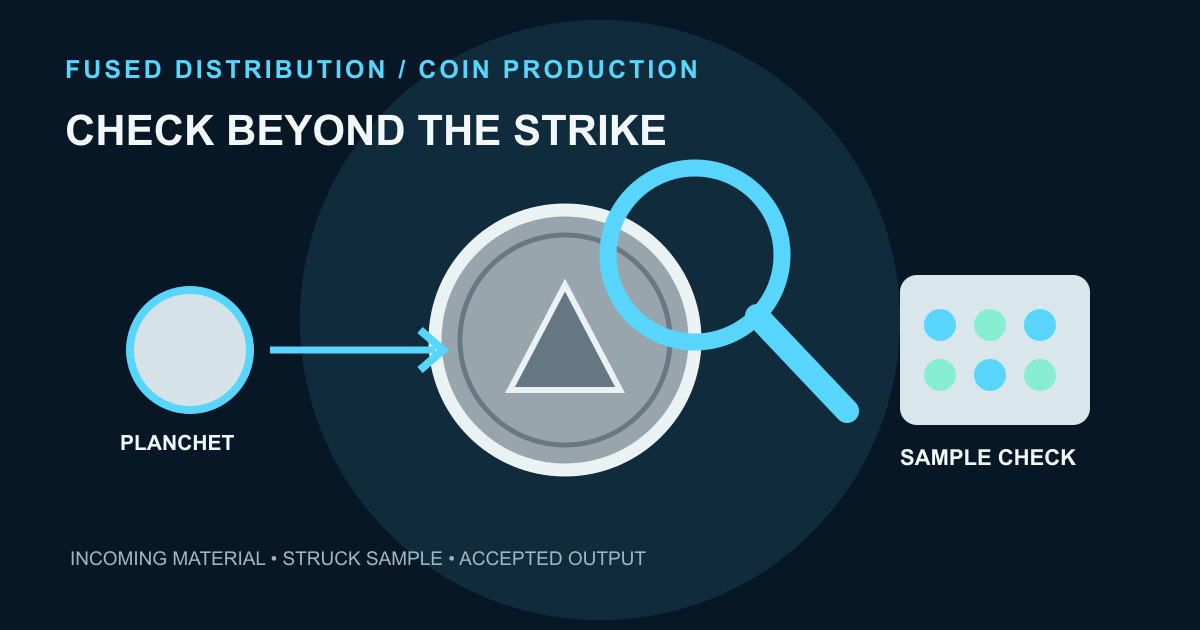
Incoming planchets → Check specifications
After striking → Inspect samples for errors
Accepted circulating output → Count and weigh
Coin quality control can happen at more than one point in production. The U.S. Mint describes incoming planchet checks and post-strike inspection. For circulating coins, sampled pieces are examined for errors; coins that do not meet certain standards may be diverted before packaging. That does not mean every coin receives the same inspection or that a production check is the same as a collector grade.
This article describes the U.S. Mint’s published process as a concrete example. Other mints, products and production lines can use different checks. The official source does not provide a universal inspection checklist for every coin producer.
Check coin planchets before striking
A planchet is a prepared metal piece that will be struck into a coin. The U.S. Mint says inspectors check purchased planchets to make sure they meet the required specifications. This check happens before the press transfers a design. It concerns the material entering production, not a grade assigned to a finished collectible.
The Mint’s coin production overview describes the broader path from design to finished piece. The exact steps depend on the product and whether the Mint makes or purchases the blanks or planchets.
Inspect coin samples after the press
After striking, the Mint says an inspector examines samples for errors. This is a sample-based check in the process described on its production page. It should not be paraphrased as an individual hand inspection of every circulating coin. A sample can help identify a production issue, while the published page does not specify a universal sampling rate.
The press creates the design through pressure from obverse and reverse dies. The article on how a coin collar shapes the strike explains another part of the physical process. Inspection and die setup answer different questions about the finished result.
Separate coin production checks from collector grading
Production inspection checks whether output meets the producer’s process standards. A collector grade describes condition under a grading system and can involve separate evaluation after a coin enters the market. One does not guarantee the other. A coin can pass production checks without being a perfect specimen, and a production error does not automatically establish rarity or value.
The Mint’s public process page says that circulating coins that fail certain standards may be sent to a waffler, which bends them before recycling. The description is specific to its circulating coin workflow. Do not assume the same outcome for proof, bullion, foreign or privately minted products without a source for that process.
Check accepted coin output after inspection
After circulating coins pass inspection, the Mint says they are counted and weighed before bagging. Those steps help prepare accepted output for packaging and distribution. They do not replace the preceding inspection, and a bag weight alone does not establish the condition of each coin inside it.
When comparing claims about quality, identify the producer, product type and inspection stage. Ask whether the source describes incoming material, sampled strikes, finished product or collector grading. Keeping those stages separate makes it easier to understand what a quality statement actually confirms.
Sources
- U.S. Mint: Coin Production: incoming planchet checks, post-strike sample inspection, handling of some circulating coins that fail standards, and counting and weighing after inspection.
- U.S. Mint: Superior Manufacturing Reduces Errors: background on the Mint’s quality measures; not used to generalize its process to other producers.
Related
Which part of coin inspection would you most want to see explained: planchets, sample checks or rejected pieces?
Read next: See what a coin collar does during striking.