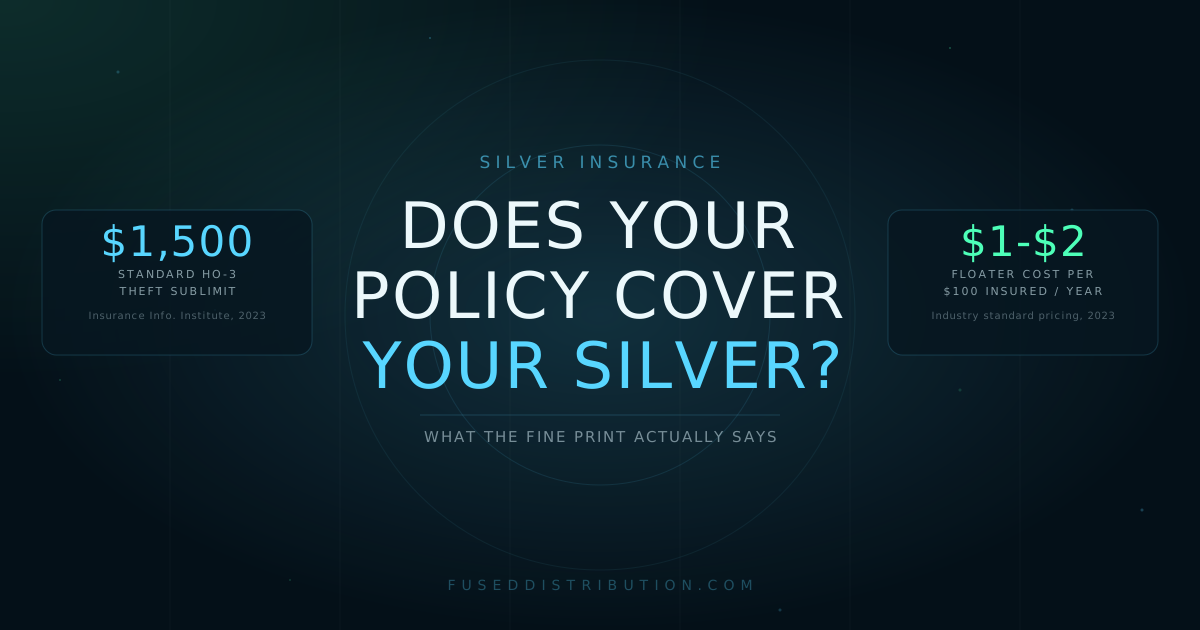
Most people who store silver at home assume their homeowner's insurance covers it. It does — but not the way you're probably thinking. Standard HO-3 policies set a per-theft sublimit on jewelry, silverware, and precious metals that typically sits at $1,500, according to the Insurance Information Institute (III). A 100-ounce silver stack at current spot prices is worth roughly $3,200. If it's stolen, you'd recover less than half.
This post explains exactly what your standard policy covers, which scenarios pay out in full versus hit the sublimit, and how a scheduled personal property floater closes the gap for a fraction of what your silver is worth.
What a Standard HO-3 Policy Actually Says About Silver
A standard HO-3 homeowner's policy covers your personal property against 16 named perils, including fire, smoke, theft, vandalism, and water damage from burst pipes. Fire coverage for silver generally applies at full replacement value up to your personal property limit, which is typically set at 50-70 percent of your home's insured value. That's not the problem.
The problem is theft. HO-3 policies routinely impose per-category sublimits on high-value personal property, including jewelry, watches, silverware, gold, and silver bullion. The III notes that these sublimits commonly land between $1,500 and $2,500 across major carriers — regardless of your overall personal property limit. So a homeowner with $200,000 in personal property coverage can still walk away with only $1,500 after a silver theft.

Two additional gaps exist that many stackers don't think about. First, flood damage is not covered by any standard homeowner's policy — you need a separate FEMA National Flood Insurance Program (NFIP) policy or private flood coverage for that. Second, mysterious disappearance — meaning your silver is simply missing with no evidence of theft — is specifically excluded from standard HO-3 language. If you can't prove a break-in, the claim may be denied outright.
The Three Loss Scenarios That Determine Your Payout
Not every loss scenario hits the sublimit. Here's how three common situations play out under a standard HO-3 with no additional coverage:
House fire — your silver typically pays out at market value up to your overall personal property limit, with no sublimit applying. Most carriers don't restrict fire coverage for bullion the same way they restrict theft. A complete loss in a fire, while catastrophic, is more likely to be fully covered than a targeted theft.
Burglary with forced entry — this is the theft scenario where the sublimit kicks in hard. Your silver is stolen, there's a police report, but the payout is capped at the sublimit regardless of what was taken. At $1,500 and a spot price of $32 per ounce, that's 47 ounces recovered out of a 100-ounce stack.
Silver missing without explanation — no payout at all under most standard HO-3 policies. Mysterious disappearance exclusions are standard language across Allstate, State Farm, Nationwide, and most other major carriers. Without evidence of theft, vandalism, or a covered peril, the claim has no basis.
How a Scheduled Personal Property Floater Fills the Gap
A scheduled personal property endorsement, sometimes called a floater, adds coverage for specific items at their full appraised or documented value. For precious metals, most insurers price these at $1 to $2 per $100 of insured value annually, according to the Insurance Information Institute. That's $32 to $64 per year to insure a $3,200 silver stack — less than the cost of two ounces at current prices.
What the floater does differently from your base policy:
- No theft sublimit — the item is scheduled for its full appraised value
- Mysterious disappearance covered — loss without evidence of theft is included
- Agreed value or replacement value — you get what it's worth, not what you paid
- No deductible on most floaters — or a very low one compared to your main policy
To add a floater, contact your current insurer and request a scheduled personal property endorsement. You'll need documentation — typically purchase receipts, current spot price calculations, or a dealer appraisal for numismatic pieces. The insurer sets the coverage amount based on your documentation, and it stays in force as long as you renew.

How to Document Your Stack Before You Need a Claim
The claim process goes much faster when your documentation is already done. Adjusters need evidence of what you owned and what it was worth at the time of loss. Most people don't think about this until something has already happened.
A simple documentation process that takes about 30 minutes:
- Photograph every item individually — coin by coin, bar by bar — against a neutral background
- Record weight, mint mark, year, and condition for each piece in a spreadsheet
- Note the purchase source and price for each lot (dealer invoice or screenshot works)
- Save a copy of the spreadsheet and photos to cloud storage — not just on your home computer
- Update the record whenever you add to your stack
For numismatic coins, a third-party graded holder (PCGS or NGC) makes documentation automatic and adds a premium value anchor for the insurer. For standard bullion, COMEX spot price at the time of the claim sets the value basis.
Once you have this record, share it with your insurer when setting up the floater. Most will accept it as the basis for coverage without requiring an independent appraisal for standard bullion. Rare or graded coins may need a formal appraisal to get the numismatic premium recognized.
Sources
- Insurance Information Institute, "Homeowners Insurance Coverage for Valuable Items," retrieved 2026-06-03, iii.org
- Insurance Information Institute, "Floater Policies for Valuable Items," retrieved 2026-06-03, iii.org
- FEMA, "What Is Covered by Standard Flood Insurance," retrieved 2026-06-03, floodsmart.gov
- Insurance Information Institute, "Understanding Your Homeowners Policy," 2023, iii.org