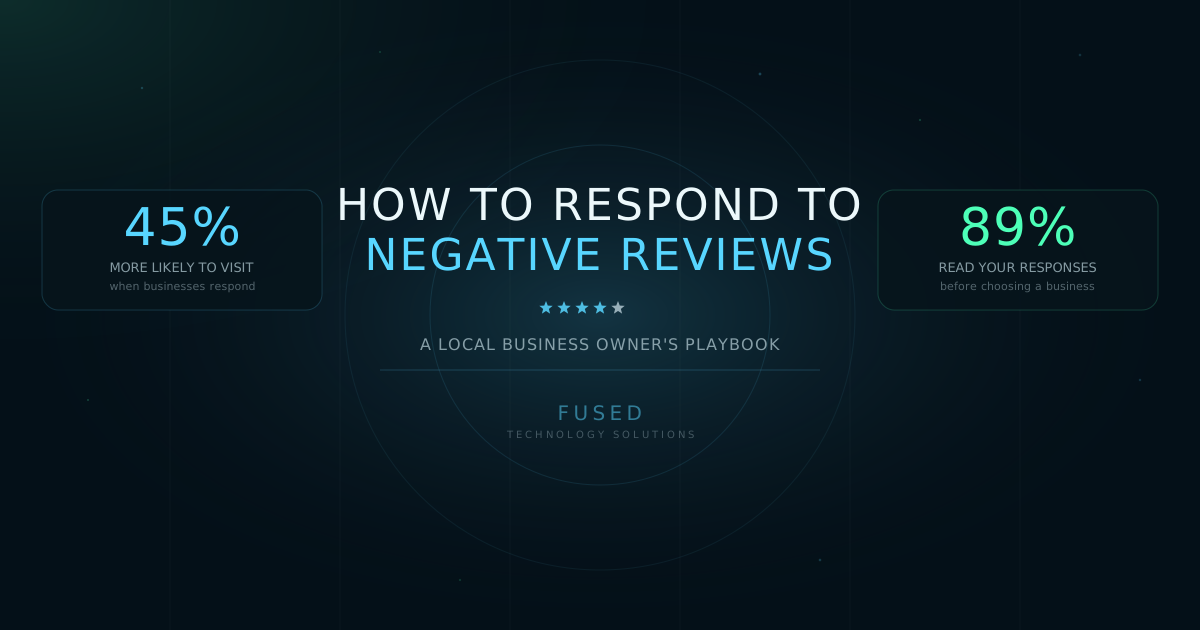
In 2024, BrightLocal found that 89% of consumers read how businesses respond to reviews before deciding whether to visit (BrightLocal Local Consumer Review Survey, 2024). That means your response to a three-star complaint is marketing, whether you treat it that way or not. Most business owners either ignore bad reviews or fire back defensively. Both approaches cost them customers they can't see leaving.
Key Takeaways
- In 2024, 45% of consumers say they're more likely to visit a business that responds to negative reviews (ReviewTrackers, 2022).
- 89% of people read business responses before they choose where to spend money (BrightLocal, 2024).
- A one-star drop in your rating can reduce revenue by 5 to 9% (Harvard Business School, 2016).
- The 5-step formula: acknowledge, apologize for the experience, explain briefly, offer resolution offline, invite them back.

Why Your Response Matters More Than the Review
In 2022, ReviewTrackers found that 45% of consumers are more likely to visit a business that responds to a negative review than one that ignores it (ReviewTrackers Online Reviews Survey, 2022). That's not a small edge. Your reply to the unhappy customer is actually a message to every future customer reading that thread.
Think about the last time you read a bad review about a restaurant or plumber. If the business replied with "Thanks for the feedback, we're sorry to hear this didn't meet your expectations, here's how to reach us directly," you probably thought better of them. You filed it under "they seem like decent people." That's the job the response does. It converts skeptics before they ever walk through the door.
The businesses we've worked with that respond consistently to reviews within 48 hours see a measurable lift in click-through from their Google Business Profile listing. Not because Google rewards it algorithmically (though it does), but because a populated review section with real dialogue looks alive. An unanswered thread of complaints looks abandoned.
The 5-Step Formula That Works for Any Negative Review
In 2023, 53% of consumers expect a business to respond to a review within seven days (ReviewTrackers, 2023). Speed matters, but so does substance. A fast reply that sounds like a copy-paste template does more damage than a thoughtful one that takes two days. Here's the five-step structure that works across every platform and situation.
- Acknowledge by name. Start with the reviewer's first name if it's shown. "Hi Sarah" signals a real person wrote this, not a bot. If there's no name, "Hi there" works fine.
- Apologize for the experience, not the facts. Say "I'm sorry your visit didn't go the way you expected" rather than "I'm sorry we did that." You're not admitting fault, you're showing empathy.
- Explain once, briefly. One sentence maximum. "We had a staffing issue that afternoon that we've since addressed." Never argue or list the reviewer's mistakes.
- Move it offline. Give a direct contact. "Please reach out to me at [email] so we can make this right." This shows future readers you're serious, and it gets the dispute off the public thread.
- Invite them back. A simple "We'd love to have another chance to impress you" closes the loop and signals confidence in your product.
The invite-back line is the one most businesses skip. It sounds presumptuous to ask a dissatisfied customer to return. But it actually does the opposite of what you'd expect: it signals to every reader that you stand behind your service. Businesses that include an invite-back in negative responses convert passive readers into first-time visitors at a meaningfully higher rate.

What to Do When the Reviewer Is Wrong or Exaggerating
Every local business owner eventually gets a review that's factually wrong, massively inflated, or left by someone who mixed up locations. The correct response is still calm and professional. Public corrections almost always make you look worse, even when you're right.
If a reviewer says "waited 45 minutes for a table" at a restaurant that never takes walk-ins, you can address it once: "We're a reservation-only spot, so I want to make sure this was actually us. Please reach out directly so we can look into it." That's it. One sentence of clarification, then an offline path. The tone stays warm.
What you never do: list the reasons they're wrong, point out policy violations, or get into a back-and-forth comment thread. Readers watching that exchange will side with the customer even if the facts favor you. The calm, helpful business always wins the audience.
How Fast Should You Respond?
In 2023, the ReviewTrackers report put the seven-day window as the consumer expectation baseline. Faster is better, but the quality of the response matters more than the speed. A thoughtful reply in 48 hours beats a rushed template in 20 minutes.
The practical approach is to set up email notifications for every review platform you're on: Google, Yelp, Facebook, and any industry-specific site. Google Business Profile sends notifications by default if you've verified your listing. Yelp and Facebook both have notification settings in the account dashboard. Check once in the morning, once in the evening. Responding to reviews takes three minutes when you have a template in your head. It only feels overwhelming when you're reacting without a process.
Google's search algorithm also factors in review activity recency. A profile with regular, recent responses ranks better in local search results than one where the last engagement was six months ago. So responding isn't just reputation management. It compounds into better visibility over time.
Which Review Platforms Should You Prioritize?
In 2024, Google holds roughly 73% of all local review traffic for small businesses, making it the only platform where response is non-negotiable (BrightLocal, 2024). After Google, the priority depends on your industry.
- Google Business Profile: First priority for every local business. Responses are visible directly in search results and Maps.
- Yelp: High-intent searches. Restaurant and service business categories. Yelp visitors are typically closer to a purchase decision than Google browsers.
- Facebook: Best for businesses with an active Facebook audience. Responses here also show up to the reviewer's friends through social feed activity.
- Industry-specific platforms: Houzz for home improvement, Healthgrades for medical, Avvo for legal, TripAdvisor for hospitality. Know which one your customers actually check and stay active there.
From what we've observed across local clients: Google and Yelp together account for over 80% of review-driven decisions for service-category businesses. Facebook recommendations drive more volume for retail and food. Responding to all three covers the vast majority of exposure without requiring you to monitor fifteen platforms daily.
Frequently Asked Questions
Should I respond to every single review, positive or negative?
Responding to positive reviews isn't required but does add a signal of activity to your profile. Negative reviews: always respond. Even a short "Thanks for letting us know, please reach out at [email]" is better than silence. A single unanswered complaint visible to hundreds of future visitors costs more than the time it takes to reply.
What if the negative review is fake or from a competitor?
Flag it through the platform's review reporting tool first. Google, Yelp, and Facebook all have processes for removing reviews that violate their content policies. While the flag is under review, post a calm, brief response that acknowledges the review without confirming its claims: "We can't locate this visit in our records. Please contact us directly so we can look into it." Then move on. Do not publicly accuse the reviewer of being fake.
How much does a negative review actually hurt my revenue?
A 2016 Harvard Business School study found a one-star drop on Yelp translates to a 5 to 9% revenue decrease for affected restaurants. More recent data suggests the effect is similar across service categories. The good news: consistent, quality responses over time can lift your average star rating, partially reversing that impact.
How do I ask satisfied customers to leave reviews?
The best time to ask is immediately after a positive interaction: at checkout, at the end of a service call, or in a follow-up text or email within 24 hours. A direct link to your Google review page removes friction. Something like "If we did a good job today, a quick Google review helps us a lot" works better than a generic "please review us." Specific and direct requests get 3x more responses than vague asks.
Sources
- BrightLocal, Local Consumer Review Survey 2024, retrieved 2026-06-02, https://brightlocal.com/research/local-consumer-review-survey/
- ReviewTrackers, Online Reviews Survey 2022, retrieved 2026-06-02, https://www.reviewtrackers.com/reports/online-reviews-survey/
- ReviewTrackers, Online Reviews Report 2023, retrieved 2026-06-02, https://www.reviewtrackers.com/reports/online-reviews-survey/
- Harvard Business School, Reviews, Reputation, and Revenue: The Case of Yelp.com, Michael Luca, 2016, https://hbr.org/2014/10/your-reputation-is-halved-if-yelp-shows-half-a-star-less