Record the manual baseline → Count review and correction effort
Check quality before comparing speed → Decide what to change next
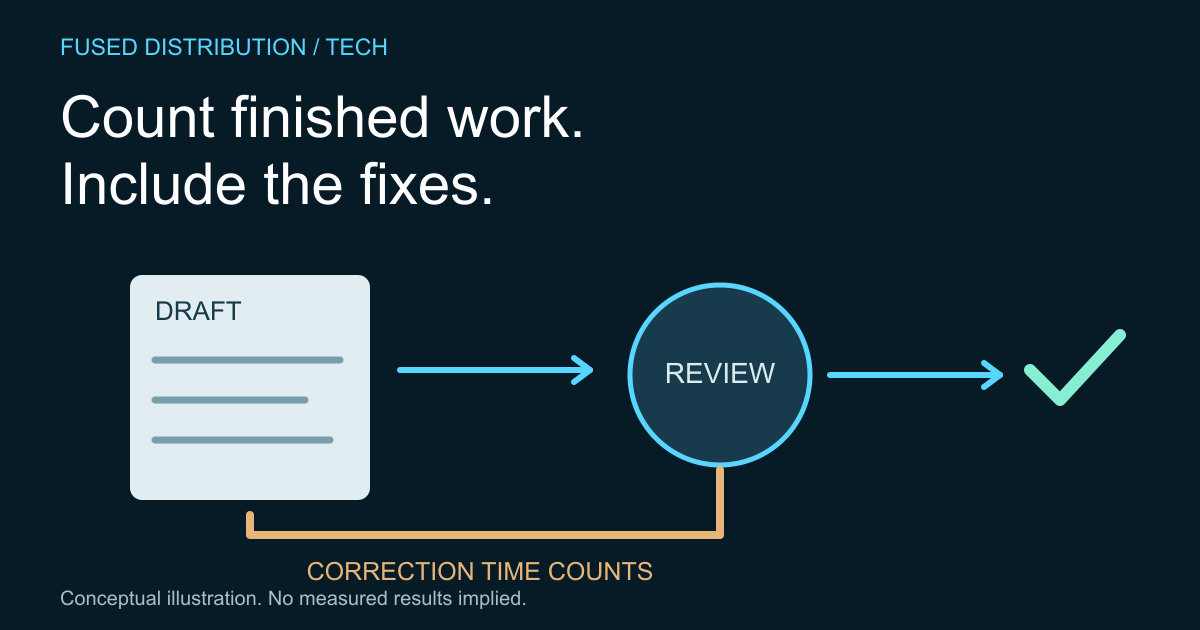
An automation can produce many drafts while leaving the team with more work. Count a task as complete only when it meets the same acceptance criteria used for manual work. Then measure the effort required to reach that point, including review, corrections and any follow up caused by mistakes.
Choose one bounded workflow for the first comparison. A customer support draft, for example, might need the correct policy, an appropriate tone and an explicit handoff when account information is missing. This article offers a practical measurement method; it does not claim that a particular tool saves time.
Record a baseline for completed tasks
Take a small, authorized set of representative cases and record how they are currently completed. Separate hands on work from waiting time. Note difficult cases rather than removing them because they make the average look worse. Keep confidential customer information out of the measurement sheet.
Our guide to choosing a first AI task can help establish the boundary. Compare like with like: a checked, ready draft should not be compared with an unchecked generated answer. Write the acceptance rule before inspecting the trial results.
Count review and correction effort
For each trial case, record initial preparation time, review time, correction time and whether the result passed. Add a short error category, such as missing fact, wrong policy or unclear instruction. Avoid vague scores that cannot explain what the reviewer actually had to repair.
Record rejected outputs as part of the trial. A tool that produces a usable answer only after several attempts has consumed effort on those attempts too. If the reviewer starts again manually, include that work. The useful number is the total effort needed for an acceptable result, not only the first generation time.
Check quality before comparing speed
Use the same acceptance criteria for both approaches. A faster process that silently drops important checks is a different process, and its speed does not establish an improvement. The support draft test set guide explains defining expected outcomes for difficult inputs.
Look at failures individually as well as at totals. One serious incorrect action may matter more than several small wording corrections. Keep severity and frequency separate so a simple average cannot hide the type of error that should stop a rollout. Define any stop condition before expanding the trial.
Decide what to change next
Summarize completed cases, failed cases, total effort and the most common correction. Treat a small trial as evidence about those cases, not proof of universal savings. If results vary sharply, identify which case types need a different approach or must stay with a person.
Choose one next change, such as clearer input requirements or a narrower task boundary, and repeat the same comparison. Preserve the earlier version and results. That makes improvement visible and keeps the team from confusing a new prompt, a different case mix and a genuine reduction in rework.
Sources
- Original practical guidance. No product capability, benchmark or measured savings claim.
Related
- Choosing a low risk first ai task for a small business
- Building a test set for ai customer support drafts
Read next: Choosing a low risk first ai task for a small business.