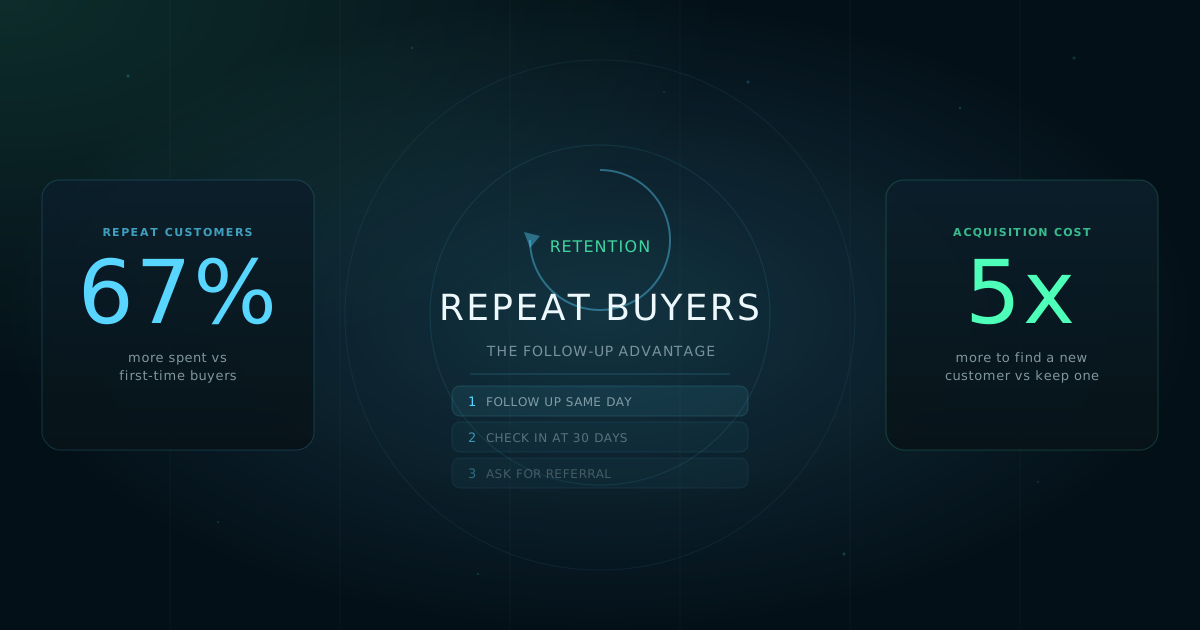
Most local businesses spend 90% of their marketing budget chasing people who've never heard of them. The customers who already paid them once, liked what they got, and are the most likely to come back again, those customers get almost no attention after the job is done.
That gap is expensive. Returning customers spend 67% more than new ones on average. They're easier to sell to, cheaper to reach, and more likely to send referrals. A simple follow-up system pays better than most paid advertising.
What Repeat Customers Are Actually Worth
The probability of selling something to an existing customer runs 60-70%. For a new prospect, it's 5-20%. That gap exists because trust is already there. They know your work, they know you showed up, and they've already done the mental work of comparing you to competitors.
A 5% increase in customer retention can raise profits anywhere from 25% to 95%, depending on your margins and customer lifetime value. Each retained customer compounds over time: they buy more, refer others, and cost nothing to find.
Most local service businesses have a long list of past customers and no system for staying in touch with them. That list is the most underused asset in their business.
The Three-Step Follow-Up System
Most local businesses lose repeat customers not because the customer was unhappy, but because nobody followed up. The customer finished the job, moved on with their life, and the next time they needed something similar, they searched again and called whoever came up.
Step 1: Collect contact info at the close of every job. You can't follow up with someone you have no way to reach. A name, phone number, and email at the end of every job is the minimum. A simple note in your phone or a short intake form handles this. If you're getting paid, get their contact details.
Step 2: Send a follow-up the same day or next morning. A text or email that says "Thanks for choosing us, let us know if anything comes up" takes 30 seconds. It costs nothing. It sets you apart from the 80% of service businesses that go completely silent after payment. For most service businesses, this one step alone doubles the callback rate when that customer needs work done again.
Step 3: Check back at 30 days with a specific reason. Not "just checking in," which reads as a sales pitch. A message like "Hey, just making sure everything is still holding up well" is a service check. It signals you care about the result, not just the transaction. Most service businesses never do this. The ones that do consistently get more referrals and more repeat calls.
How to Ask for Referrals
Don't ask for a referral right when the job ends. The customer just paid and their mind is already on the next thing. The right moment is the 30-day check-in, when they've lived with the result and are satisfied with it.
Say this: "If you know anyone who could use what we did for you, I'd really appreciate the recommendation." That's the whole script. No incentives, no awkward formality. Direct and short works because it sounds like a person, not a sales funnel.
The Simplest Loyalty Move
You don't need a points program. You don't need an app or a loyalty platform. The simplest move is to remember your customers.
Keep a short note on each customer: what you did for them, anything notable about the job or their situation. When you follow up, reference it. "How's the deck holding up?" is worth more than any discount code because it proves you paid attention. That's what turns a satisfied customer into a regular. Not perks. Recognition.
The businesses that consistently win repeat customers aren't running the best ads. They're running the best follow-up. It costs almost nothing and it compounds every month.
Sources
- Bain & Company. "Prescription for Cutting Costs." Reichheld, Frederick. bain.com
- Farris, Paul et al. "Marketing Metrics: The Definitive Guide to Measuring Marketing Performance." Pearson Education.
- Harvard Business Review. "The Value of Keeping the Right Customers." reichheld.com
- Invesp. "Customer Acquisition vs. Retention Costs." invespcro.com