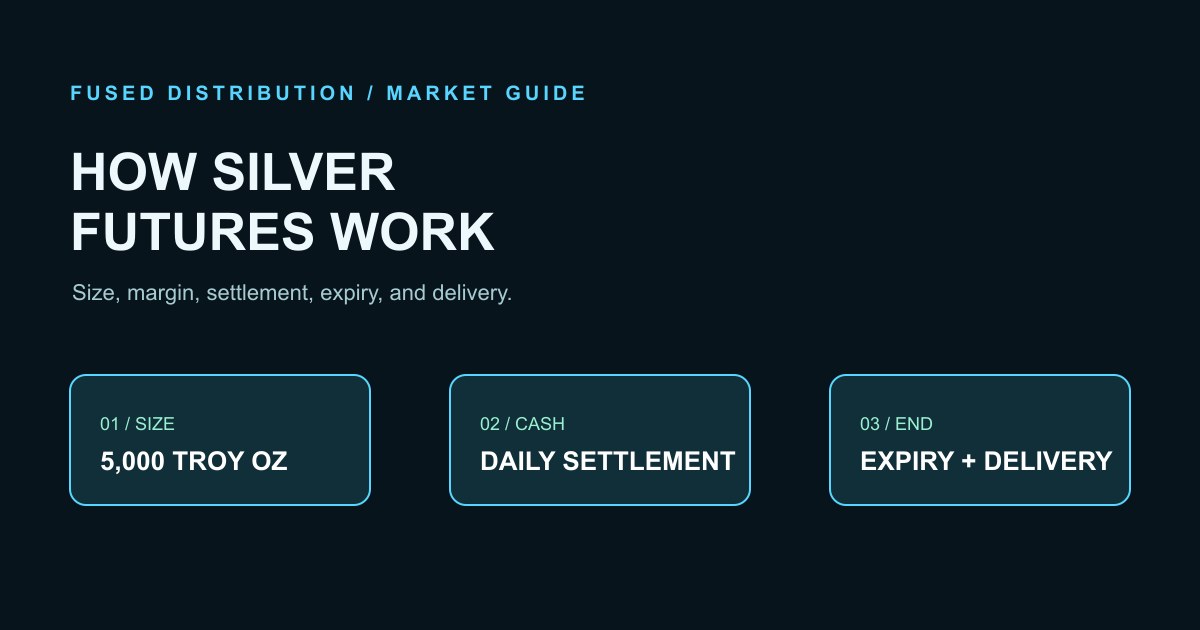
Silver futures are standardized agreements traded on an exchange. They let market participants transfer price exposure to a specified future contract month, with rules for size, quotation, settlement, margin, expiry, and delivery. A futures contract is not the same thing as buying a silver coin or bar. This guide explains the mechanics so stackers can read futures news more carefully. It does not recommend trading, predict prices, or tell anyone how much capital to risk.
What a futures contract represents
A futures contract specifies a commodity, quantity, quality, delivery location or settlement process, contract month, and exchange rules. The contract’s quoted price is usually stated per troy ounce, while the contract’s total exposure equals the quoted price multiplied by the contract unit. The CME Group standard Silver futures contract represents 5,000 troy ounces and uses U.S. dollars and cents per troy ounce.
That multiplication matters. If a purely hypothetical quote were $30 per troy ounce, one standard contract would have a notional value of $30 × 5,000 = $150,000. This is an illustration of contract arithmetic, not a live quote or a recommendation to trade.
Contract size and smaller products
Standard size is only one product choice. CME also lists smaller silver futures products, each with its own contract specifications and settlement rules. Never infer a smaller contract’s tick value, expiry, or delivery treatment from the standard contract. Open the current exchange specification for the exact product code and month.
Contract size also explains why a small per ounce move can create a large dollar change. For a 5,000 ounce contract, a hypothetical $0.10 per ounce move changes notional exposure by $0.10 × 5,000 = $500. That arithmetic describes sensitivity; it does not describe a likely move.
Margin is performance security
Futures margin is a performance bond, not a down payment that buys the metal. A clearing member or broker collects margin under applicable rules. Initial margin supports opening a position; maintenance margin is a continuing minimum that can trigger a request for additional funds if the account falls below it. Requirements can change, and brokers may impose amounts above exchange minimums.
Do not hardcode a current margin number into an educational calculator. Instead record the product, date, source, and published requirement you are reviewing. Notional value divided by margin produces a rough leverage ratio, but that ratio changes when either the quote or margin changes. It also omits fees, liquidity, and the possibility of rapid losses.
Variation and daily settlement
Futures positions are marked to a daily settlement price. Gains and losses are credited or debited through the clearing system as variation. This daily cash movement is different from waiting until a physical bar is sold. A position can require additional funds before its contract reaches expiry.
The daily process is why a person can be directionally correct about a later price and still face an interim funding problem. A chart that shows only the final price does not show the path, settlement timing, or cash requirements along the way.
Expiry and delivery
Every contract month has rules for the last trading day, notices, and delivery or settlement. CME’s standard Silver futures specification describes physical settlement, a 5,000 troy ounce contract unit, minimum .999 fineness for deliverable silver, and delivery during the designated delivery period. The exact dates and procedures belong to the current rulebook and contract month.
Holding a deliverable contract toward expiry is therefore an operational decision. A participant must understand notice procedures, clearing relationships, approved brands, warrants or warehouse arrangements, financing, insurance, transport, and the obligations that apply if delivery is assigned. A retail stacker should not assume that a futures position automatically becomes a parcel of retail coins.
Delivery is not the same as spot ownership
Physical delivery uses exchange approved forms and procedures. A 5,000 ounce contract may involve large bars or approved units rather than the products seen in a local shop. The exchange specification controls what qualifies. A cash settled product has different mechanics and does not create the same delivery obligation.
Read the settlement type before comparing products. A headline that says silver futures does not tell you whether the referenced contract is physically deliverable, cash settled, or a spread. Product code and contract month are essential identifiers.
Price discovery and basis
Futures prices are part of price discovery, but they are not identical to every local dealer’s retail quote. A retail quote can include fabrication, refining, financing, shipping, insurance, taxes, inventory, and a dealer premium. In commodities, basis usually compares a cash price with a specified futures price. A retail coin premium is a separate measure and should not automatically be treated as that basis. Any comparison needs matching units, location, timing, and product quality.
For a useful comparison, write down the contract month, quotation unit, settlement price time, physical product, currency, and all added costs. Comparing a futures price per troy ounce with a delivered one ounce coin price without adjustments answers no clear question.
Inventories and open interest
Open interest counts outstanding contracts, while an exchange inventory report describes metal held in specified categories and facilities. Neither number is a complete count of all privately held silver. A change in open interest is not the same as a change in warehouse stocks. A warehouse category may also have eligibility or delivery conditions that affect interpretation.
Use the exchange’s definitions and date. Avoid converting a headline inventory number into a claim about immediate retail availability. Metal movement, warrant status, approved brands, and delivery timing can all matter.
A bounded arithmetic example
Imagine a hypothetical 5,000 ounce contract and a hypothetical $0.10 per ounce daily change. The contract’s mark-to-market change is $0.10 × 5,000 = $500. If a second hypothetical day moves $0.25 per ounce, the change is $0.25 × 5,000 = $1,250. These figures demonstrate multiplication and daily settlement sensitivity. They do not estimate a future price, return, margin call, or outcome.
<div class="chart-wrap"><div class="chart-title">Contract exposure example</div><p><strong>5,000 troy ounces × $30 per ounce = $150,000 notional</strong></p><p><strong>5,000 troy ounces × $0.10 per ounce = $500 change</strong></p><p class="chart-note">Hypothetical arithmetic only; no live quote or trading advice.</p></div>
Margin and position size are separate questions
The number of contracts is a separate choice from the margin percentage. Multiplying contracts by contract size gives gross notional exposure. Margin requirements describe collateral under the applicable clearing rules; they do not cap the economic effect of a price move. A position can also face commissions, exchange fees, spread costs, financing, and liquidity constraints. Those details are why a simple leverage ratio is only a description of one moment, not a measure of safety or suitability.
Questions to ask when reading futures coverage
Identify the exchange, product code, contract month, contract size, quote unit, settlement type, last trading date, and source date. Then ask whether the article is discussing price exposure, hedging, delivery, inventories, or retail premiums. Those are related topics with different evidence.
For physical context, read What Is COMEX Silver And How Does It Affect Spot Price and Silver Premiums Explained For Beginners. For record keeping, see How To Build A Silver Inventory Spreadsheet.
Related
- What Is COMEX Silver And How Does It Affect Spot Price
- Silver Premiums Explained For Beginners
- How To Build A Silver Inventory Spreadsheet
Read next: What Is COMEX Silver And How Does It Affect Spot Price