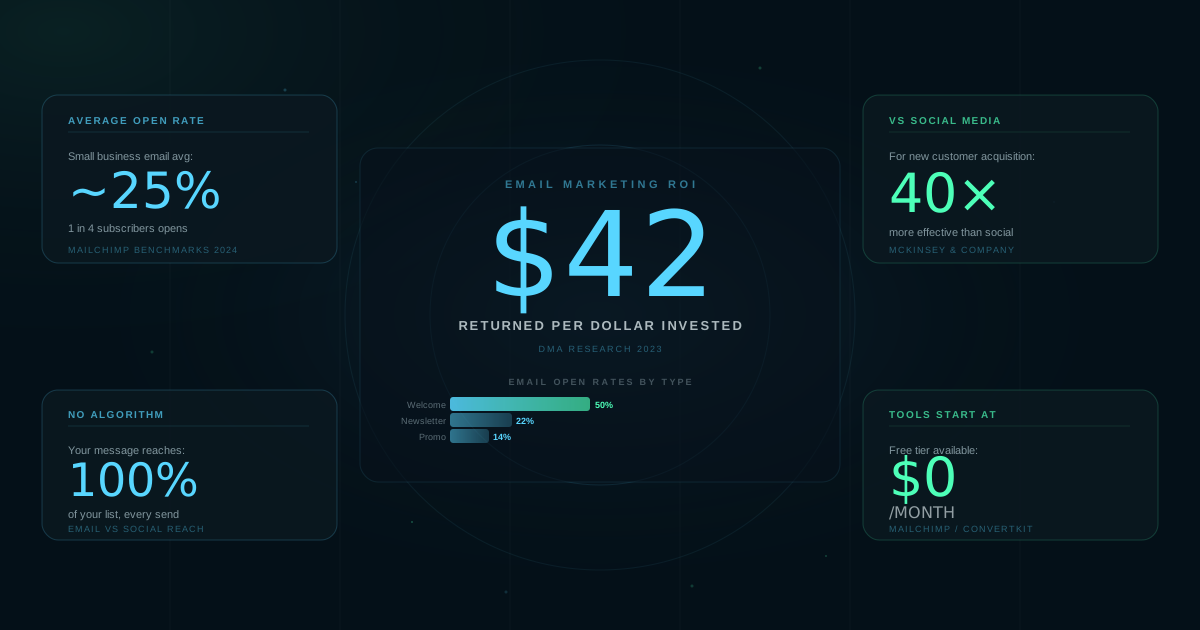
Email marketing delivers $42 back for every $1 spent. That is the highest return of any digital channel, and that number has held up for over a decade. Social ads stop working the moment you stop paying. Organic reach on most platforms gets throttled by algorithms. Your email list belongs to you.
Most local businesses are sitting on a customer base they have no reliable way to reach directly. Here is how to fix that.
Why Email Works for Local Businesses
No algorithm decides who sees your message. If someone is on your list and you send an email, it lands in their inbox. That directness is what makes email different from any social platform.
Three things make it particularly useful for local businesses:
- Your customers already trust you. They bought from you at least once. Getting them back costs a fraction of what it costs to acquire someone new.
- It scales without proportional cost. Sending to 100 people or 10,000 people costs roughly the same inside most email tools.
- You own the list. If a platform changes its rules or your ad account gets flagged, your email list is still yours. No one can take it away.
How to Start Building Your List
You need two things: a way to collect emails and a reason for someone to give theirs.
Add a sign-up form to your website. This is the simplest starting point. Put it in your site footer and on a dedicated page. Offer something in return: 10% off a first order, early access to new products, or a short guide relevant to what you sell. People hand over their email address when there is a clear benefit attached.
Collect emails at the point of sale. If you have a physical location, ask for an email when someone buys. Frame it as helpful: "Can I grab your email to send your receipt and let you know about new products?" That phrasing converts well because it sounds practical rather than promotional.
Run a lead magnet campaign. A lead magnet is something your customer wants enough to trade their email for. For a restaurant, a recipe works. For a service business, a checklist. For a retailer, a coupon. It does not need to be elaborate. It needs to be genuinely useful to your specific customer.
What to Send
Once you have a list, the question is what to actually put in the emails.
Welcome email. Send this immediately when someone joins. Introduce your business, remind them what they signed up for, and deliver whatever offer you promised. Welcome emails get the highest open rates of any campaign type, around 50%, because interest peaks at the moment of sign-up.
Monthly or bi-weekly newsletter. A brief update with something new, a tip relevant to your industry, and a soft offer. Keep it short. People scan emails rather than read them. Two or three short paragraphs and a clear call to action is enough.
Promotion emails. When you have a sale, new inventory, or a slow period to fill, email your list. Be direct: say what you are offering, what it costs, and when it ends. Vague promotional emails get ignored. Specific ones get clicks.
Re-engagement emails. Every six months, send a note to subscribers who have not opened in a while. Something like: "Still want to hear from us? Here is what is new." Those who do not respond can be removed, which keeps your open rates accurate and your list healthy.

Tools That Work at Small Scale
You do not need to spend money to start. Most email tools have free tiers that cover the first several hundred contacts.
- Mailchimp. Free up to 500 contacts. Easy to set up, solid templates, works for most local businesses starting out.
- Klaviyo. Better automation. Worth it if you have an online store with order data to connect.
- ConvertKit. Built for service businesses and creators. Clean interface and straightforward automation.
- Constant Contact. Older platform but reliable. Good for brick-and-mortar businesses that want simple tools without learning curves.
Pick whichever feels least complicated. You can move later. The tool matters far less than whether you send consistently.
How Long Until You See Results
Email list building is slow for the first few months. A small business with a sign-up form and consistent sending might have 200 to 500 subscribers after six months. At a 25% open rate, that is 50 to 125 people seeing every message you send. Those are people who already know you, already bought from you, and are more likely to buy again than any cold audience you could target with an ad.
The list compounds. Every subscriber you add stays until they unsubscribe. Send consistently, remove inactive subscribers every few months, and the list becomes more valuable over time, not less. A small, engaged list outperforms a large, cold one on every metric that matters.
Sources
- DMA (Data and Marketing Association) — Email Marketing Benchmark Report, 2023. The $42 ROI figure is widely cited from this annual research on email marketing returns.
- McKinsey & Company — "Why marketers should keep sending you emails," 2014. Reported email is 40 times more effective than Facebook and Twitter combined for customer acquisition.
- Mailchimp — Email Marketing Benchmarks by Industry, 2024. Average open rate data across small business accounts.
- Litmus — State of Email Report, 2024. Open rate data by campaign type, including welcome, transactional, and re-engagement benchmarks.