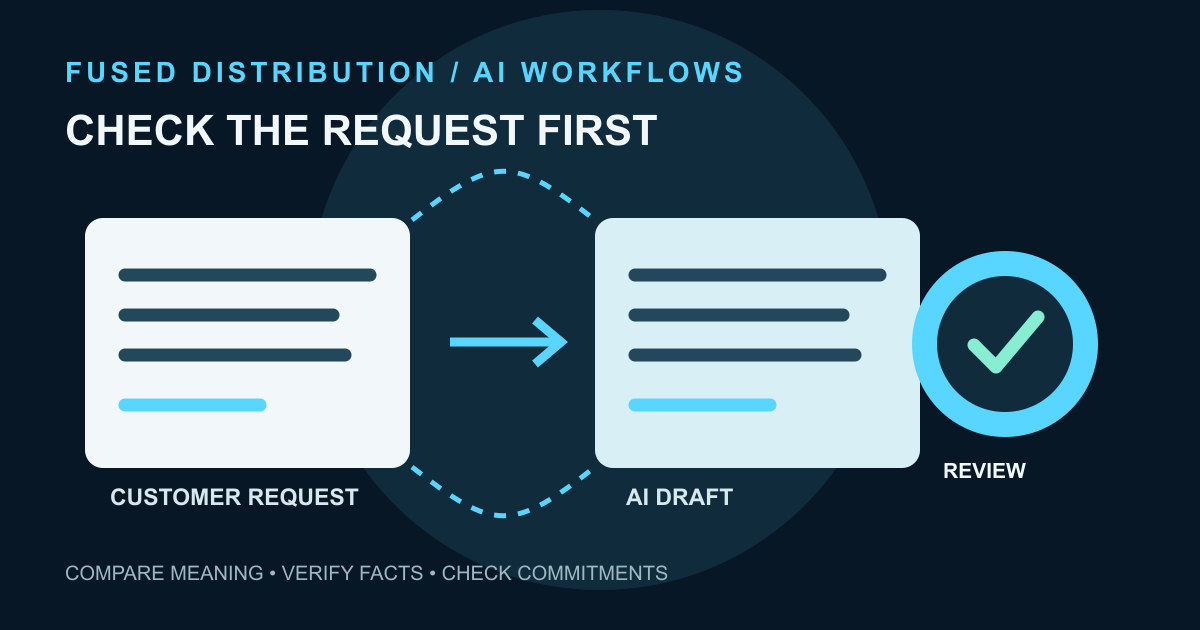
Original customer request → Proposed AI reply
Supporting source record → Human review decision
An AI draft can sound polished and still miss what a customer asked for. Compare the draft with the original request before you approve it or let it trigger a customer-facing action. Check the requested outcome, the facts the reply relies on and any promise the wording makes.
This review method is practical guidance, not a NIST checklist. NIST’s AI Risk Management Framework calls for organizations to define and document human oversight processes and responsibilities. The framework does not prescribe one review design for every business. Match the review to the task, the people affected and the consequences of an error.
Preserve the request beside the draft
Keep the original customer message available to the reviewer. Do not rely on a summary that may omit a condition, deadline or distinction. If the request refers to an order, policy or earlier exchange, show the authoritative record too. Record which version of the draft is under review so later edits do not inherit an approval they never received.
For example, a customer might ask whether a service can be completed before a specific date. A reply that describes the service accurately but confirms that date without checking capacity has not answered safely. Treat this as an example, not a claim about any particular company’s process.
Compare meaning, facts and commitments
First identify the result the customer wants. Our guide to building a test set for AI customer support drafts explains how to check examples against the task they are meant to support. Then verify factual statements against business records or current policy. Fluent wording is not proof that a detail is correct.
Read the request and draft side by side. First identify the result the customer wants. Then check whether the draft responds to that result, keeps important qualifications and avoids adding details the customer did not provide. Verify factual statements against business records or current policy rather than treating fluent language as evidence.
Pay close attention to commitments: dates, prices, eligibility, refunds, delivery, account changes and statements that imply work is complete. A person with authority over the relevant policy should approve those claims. If the source record is missing or contradictory, hold the reply and ask for the information needed to resolve it.
Hold replies when evidence is missing
Set a clear stop condition for missing order details, conflicting records or policy questions. The reviewer should know who can resolve each condition and where to send it. Do not ask a reviewer to approve a promise when its supporting record is unavailable.
If the task can wait safely, keep it in a review queue. If it cannot wait, use a documented manual process with an accountable owner. Record whether the draft was sent or changed so a later correction can address any customer impact.
Give reviewers a clear decision
Ask the reviewer to approve, revise or hold the draft. Show the original request, the relevant evidence and the proposed reply together. A broad “looks good” check makes it hard to know what was actually verified. Keep a short record of the reviewer, decision and draft version when the action warrants it.
Separate drafting permission from action permission. Approving text does not automatically authorize sending it, changing a customer record or issuing a refund. Make the allowed next step explicit. If the reviewer is unavailable, use the established manual route or wait; a missed deadline is not approval.
Learn from corrections
When a mistake reaches a customer, record what happened and what was corrected. Track recurring mismatches, such as missed conditions or unsupported promises.
Track recurring mismatches, such as missed conditions or unsupported promises. Use those examples to improve the instructions, source access or routing for the task. Test the revised workflow with both ordinary requests and cases with missing or conflicting information. Keep review in place until the evidence supports a narrower scope.
A simple log can capture the request category, mismatch type, correction and whether anything incorrect reached the customer. Limit stored personal information to what the business needs for this review. The purpose is to find a repeatable process weakness, not to collect customer data without a clear reason.
Sources
- NIST AI Risk Management Framework Core: Govern 3.2 addresses defined and differentiated responsibilities for human-AI configurations and oversight; Map 3.5 addresses defined, assessed and documented oversight processes. The comparison method and examples above are original practical guidance.
Related
Would you review every AI draft, or focus on replies that make a commitment?
Read next: Build a test set for AI customer support drafts.