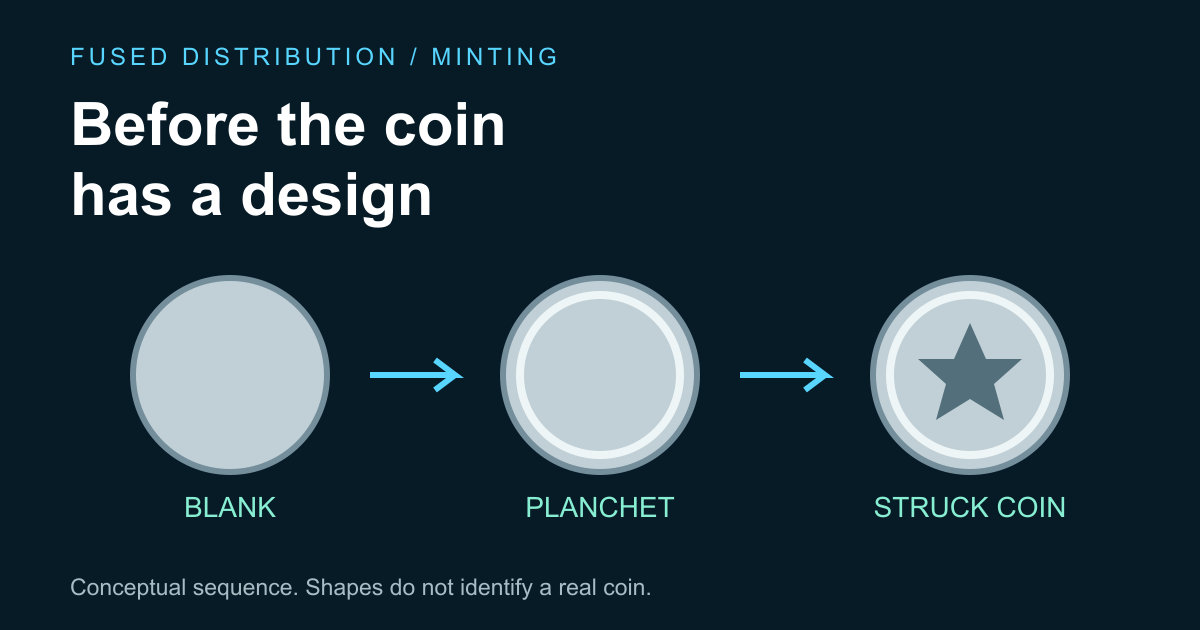
Blank → Unstruck metal disc
Planchet → Rim formed in the Mint description
Struck coin → Design impressed by dies
A blank is a metal disc used before a coin receives its design. In the U.S. Mint's production explanation, a blank becomes a planchet after a raised rim is formed around it. Striking then impresses the coin's design. The terms describe manufacturing stages, not a guarantee of rarity, value or authenticity.
The distinction is useful when reading a mint's educational material or a seller's description. It becomes less useful when a general definition is treated as a way to identify an unknown object from a photograph. Learn the process first, then keep any conclusion about a specific item separate from that lesson.
From a coin blank to a planchet
The U.S. Mint's coin production guide describes blanks as flat metal discs. Its upsetting stage raises metal around the edge to form a rim; the guide calls the resulting piece a planchet. It also notes that people sometimes use blank more broadly for a coin before striking.
That usage difference explains why two descriptions may use different words without necessarily referring to different objects. Check how the author defines the term. In a production diagram, the word may name a precise stage. In a casual discussion, it may simply mean an unstruck piece. Do not settle an identification question by choosing whichever label sounds more technical.
What striking adds to a planchet
During striking, dies press the design into the planchet. The Mint explains that the surrounding collar constrains expansion and can form the edge design. A raised rim and an edge design are therefore related features of the manufacturing story, but they are not interchangeable descriptions.
The diagram in this article simplifies the progression to an unstruck disc, a rimmed piece and a designed coin. It is not a scale drawing, and its shapes do not identify a denomination. Use it to remember the sequence rather than to compare the dimensions or appearance of something in your collection.
Read a blank or planchet listing carefully
Separate the label from the evidence. A listing may call an object a planchet while giving little information about where it came from or how that description was established. Record the exact description, source, date and any supporting documentation. If the description changes between the invoice and the listing, retain both versions instead of silently choosing one.
A useful question is: what does this record actually establish? It might establish what the seller represented, what you paid, or which object appeared in a photograph. Those are useful facts for your records. They do not automatically establish the material, production origin or specialist classification of the object itself.
Avoid adding a stronger description to your own inventory simply because it appeared in an informal discussion. You can keep an attributed note such as “seller described as a planchet” while leaving your own identification unresolved. The distinction preserves information without turning an unverified description into a conclusion.
Build a record without inventing identification
Assign an inventory identifier and connect it to the original listing, transaction record and photographs. Describe visible features in ordinary language when a technical label is uncertain. Keep the manufacturer's process explanation with your research notes, rather than presenting it as documentation for the individual object.
For example, your note could distinguish the seller's stated term from your observation that no recognizable design is visible in the available image. The observation is limited to the image. It does not establish why the design is absent, whether the object was made by a mint, or whether it is valuable. Write those limits into the record while they are still clear.
Our silver invoice checklist covers keeping transaction evidence together. The guide to photographing coins for an inventory covers linking images to the correct entry. These are documentation methods, not authentication services.
Questions the terminology cannot answer
Blank and planchet are not purity specifications. A production-stage word also does not establish a market price, certify a mint error or prove that an object came from a particular facility. If a purchase depends on one of those conclusions, ask for evidence that addresses that conclusion directly.
Likewise, a general production guide does not describe every historical minting practice or every modern product. Keep the scope of the source visible. The U.S. Mint guide used here explains its process; it should not be turned into a universal rule for all issuers and periods. A specialist description needs to identify its own context.
Do not alter an object to make it resemble an illustration or to test a theory from a blog post. This guide supplies vocabulary and a reading method. It does not provide instructions for modifying a collectible or evaluating an uncertain item's composition. A diagram can help you ask better questions while leaving the physical object and its records intact.
Use the terms as a reading tool
When you encounter blank or planchet, identify whether the writer is explaining a process or describing an individual item. For a process, note the definition and stage. For an item, note the source of the label and the evidence attached to it. This simple separation prevents a general lesson from becoming an unsupported identification.
The takeaway is the progression: a disc is prepared, a rim may be formed as described in the Mint's upsetting stage, and striking supplies the design. Keep that explanation distinct from questions about origin, material and value. Your records will be clearer when each claim is supported by the kind of evidence it actually needs.
Sources
- U.S. Mint coin production: blanking, upsetting, planchet terminology and striking.
Related
Read next: Connect coin photographs to an inventory.