Define the task → Set information boundaries
Review before action → Set a stop condition
Choose a first AI task whose output a knowledgeable person can check before it changes anything for a customer. A useful starting point is a narrow internal draft made from information you are allowed to use. Keep sending, publishing, changing records and making commitments outside the experiment until you have evidence that the complete workflow is dependable.
Low risk is a comparison within your business, not a property guaranteed by a product name. The same summarization tool can have very different consequences when it summarizes a public brochure or a confidential customer dispute. Define the work, the information and the possible harm before selecting the software.
Define the AI task in one sentence
Describe an input, an output and a reviewer. For example: “Use this approved service description to draft an internal checklist that the operations lead will compare with the source.” That is a proposed experiment, not a claim about a result already achieved. It gives you something concrete to test without connecting the tool to a customer channel.
Avoid beginning with “automate customer service” or “run our marketing.” Those phrases hide many separate decisions. A first test should be small enough that you can explain what a correct output contains, what it must omit and who notices a mistake. If the team cannot agree on those points, clarify the task before introducing AI.
Choose information with clear boundaries
Start with material you have permission to process in the selected tool. Review the tool's actual settings and terms before entering business data; do not assume a personal account and a business account handle information identically. For a first exercise, an approved public service description can make the information boundary easier to explain.
Write down the allowed source and the excluded material. The reviewer should know whether the draft may introduce outside facts or must stay within the supplied text. In a source-limited experiment, an attractive extra claim is still an error if it has no support. Do not reward the system for making the answer sound complete by filling in unknown details.
Keep a person between the draft and the action
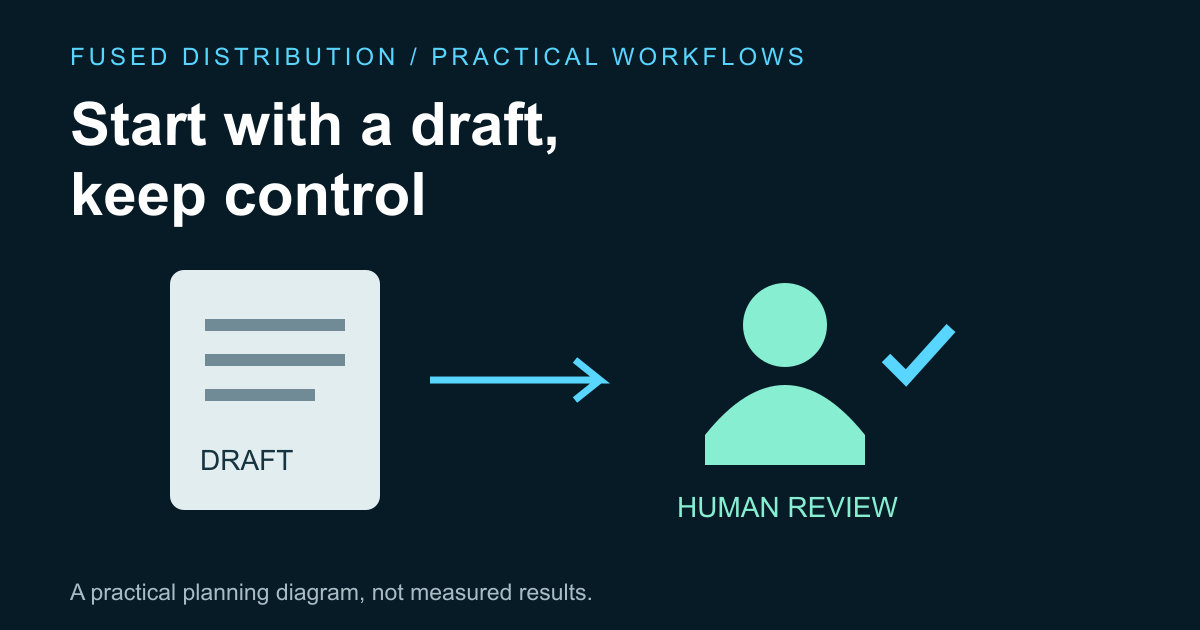
The first workflow should end at a review step. Give the reviewer the original input beside the generated draft and a short list of acceptance criteria. Check factual consistency, omissions, invented commitments and whether the wording fits the intended use. A generic instruction to “review carefully” is harder to apply consistently than a small set of explicit questions.
Keep publication and sending separate. A generated reply is not a sent reply, and a reviewed internal note is not authorization to change a customer record. If a test later includes an external action, define that as a new stage with its own approval, permissions and confirmation evidence. Do not let a convenient integration silently expand the experiment.
Test useful failure cases
Include an ordinary example, an incomplete input and an ambiguous request. These are suggested case types, not a mandatory numerical standard. The goal is to learn how the workflow behaves when the answer is not obvious. A system that asks for clarification may be more useful than one that produces a confident but unsupported completion.
Keep the examples and expected results stable while comparing changes. Record the tool configuration, prompt, source material, draft and reviewer corrections. If you change all of them at once, you will not know what helped. Preserve failed outputs as evidence of the problem, with sensitive information handled according to your business rules.
Measure the whole AI workflow
Compare the complete manual task with the complete assisted task. Include preparing the input, waiting, checking, correcting and saving the result. Do not call generation time alone a productivity improvement. Also record whether the final output was usable, because a fast draft that needs extensive correction may not help the business.
Set a stop condition before the trial. Examples include an unsupported commitment, an unapproved data disclosure or a correction burden greater than the manual process. These are proposed controls for your own trial, not measured failure rates. Keep a working manual path so ending the experiment does not interrupt the real service.
Use a framework without claiming certification
The NIST AI Risk Management Framework is intended for voluntary use and addresses trustworthiness in the design, development, use and evaluation of AI systems. It provides broader context for considering the effects of an AI workflow. Referencing it does not certify a particular tool or prove that a business process is safe.
This article's small trial is original operational guidance, not a NIST assessment or a substitute for requirements that apply to your business. If a task has substantial consequences, get the appropriate expertise before choosing it as an experiment. A simpler task with an observable result is usually easier to learn from than a broad workflow with unclear accountability.
Decide what to do after the first trial
Review the saved outputs and corrections with the person who does the work. Keep the task only if the evidence supports its usefulness within the tested boundary. You can revise the instructions, choose a narrower task or stop. A decision to stop is useful when it prevents an unreliable draft from becoming an automated action.
For any expansion, name what is changing: new input types, a different audience, more sensitive information or permission to act. Test that change explicitly. Our guide to reviewing website changes before release offers a related pattern for checking a change before customers encounter it. Use website handover records when documenting ownership and access, where applicable.
Sources
- NIST AI Risk Management Framework: voluntary framework scope. Trial steps and examples above are original suggestions, not reported customer outcomes.
Related
Read next: Review a change before customers see it.